
The complete speaking test for each exam: the examiner’s words with audio, the photographs and prompts candidates see, and a sample answer by two candidates you can listen to. Pause the examiner audio after each question and answer it yourself before you listen to the sample.
A2 Key (A2). Part 1, Part 2 of the Speaking paper. Timing on the real exam — Speaking: 8-10 minutes per pair.
Tip: Give more than one word, but keep answers short and natural: answer the question, then add one detail or reason. For the “Tell me something about …” question, try to say three or four sentences.
Part 1 (3–4 minutes). The interlocutor asks each candidate questions in turn. Candidates answer the interlocutor; they do not talk to each other in this part.
Examiner
Phase 1
Good morning. Can I have your mark sheets, please?
I’m David, and this is Helen.
(To Candidate A) What’s your name?
(To Candidate B) And what’s your name?
B, do you work or are you a student? (Back-up: Do you work? Do you study? Are you a student?)
Where do you live? (Back-up: Do you live in … ?)
Thank you.
A, do you work or are you a student? (Back-up: Do you work? Do you study? Are you a student?)
Where do you live? (Back-up: Do you live in … ?)
Thank you.
Phase 2
Now, let’s talk about food.
A, what do you usually have for breakfast? (Back-up: Do you have bread for breakfast?)
Where do you like eating lunch? (Back-up: Do you like eating lunch at home?)
B, who cooks dinner in your home? (Back-up: Do you cook dinner?)
What food don’t you like? (Back-up: Do you like fish?)
Extended response: Now, A, please tell me something about your favourite meal. (Back-up questions: When do you eat it? Who cooks it? Why do you like it?)
Now, let’s talk about shopping.
B, where do you usually buy your clothes? (Back-up: Do you buy clothes in the city centre?)
How often do you go shopping? (Back-up: Do you go shopping every week?)
A, who do you like going shopping with? (Back-up: Do you like going shopping with friends?)
What did you buy last weekend? (Back-up: Did you buy any food last weekend?)
Extended response: Now, B, please tell me something about a shop you like in your town. (Back-up questions: What does the shop sell? Why do you like it? How often do you go there?)
Thank you.
Sample answer
Model answer — Part 1 (interview)
Examiner: Good morning. Can I have your mark sheets, please? Thank you. I’m David, and this is Helen. What’s your name?
Candidate A: My name is Carla.
Examiner: And what’s your name?
Candidate B: I’m Tomasz.
Examiner: Tomasz, do you work or are you a student?
Candidate B: I work. I’m an engineer in a small company. We make parts for trains.
Examiner: Where do you live?
Candidate B: I live in a small town near the city. It’s about twenty minutes by train.
Examiner: Thank you. Carla, do you work or are you a student?
Candidate A: I’m a student. I study nursing at the university, and I also work in a café at the weekends.
Examiner: Where do you live?
Candidate A: I live with my parents, in a house near the university.
Examiner: Thank you. Now, let’s talk about food. Carla, what do you usually have for breakfast?
Candidate A: Usually I have coffee and some bread with cheese. On Sundays I have a bigger breakfast, with eggs.
Examiner: Where do you like eating lunch?
Candidate A: There is a nice café at the university, so I eat there with my friends. When the weather is good, we sit outside.
Examiner: Tomasz, who cooks dinner in your home?
Candidate B: My wife and I both cook. She cooks from Monday to Thursday, and I cook at the weekend, because I have more time.
Examiner: What food don’t you like?
Candidate B: I don’t like mushrooms. I don’t like the taste, and, er, I don’t like how they feel in my mouth.
Examiner: Now, Carla, please tell me something about your favourite meal.
Candidate A: My favourite meal is my grandmother’s chicken soup. She makes it every Sunday, when all the family visits her. It has chicken, carrots and a lot of other vegetables, and she always gives us fresh bread with it. I love it because it’s very tasty, and it makes me think of when I was a child.
Examiner: Thank you. Now, let’s talk about shopping. Tomasz, where do you usually buy your clothes?
Candidate B: I usually buy clothes online, because I don’t have much time. But sometimes I go to the shopping centre near my office.
Examiner: How often do you go shopping?
Candidate B: For food, two times a week, maybe. For clothes, not very often. Maybe once every two months.
Examiner: Carla, who do you like going shopping with?
Candidate A: With my friends. It’s more fun, and they tell me if something looks good or not.
Examiner: What did you buy last weekend?
Candidate A: Last weekend I bought a present for my brother’s birthday. It was a book about football.
Examiner: Now, Tomasz, please tell me something about a shop you like in your town.
Candidate B: There’s a small shop near my house that sells fruit and vegetables. The man who works there is very friendly, and he always remembers my name. The fruit is fresher than in the supermarket, and it isn’t expensive. I go there every Saturday morning, and sometimes we talk about football for ten minutes!
Examiner: Thank you.
Both candidates answer every question fully and without needing back-up prompts, which is what Interactive Communication rewards at this level. Their grammar is simple but well controlled (present simple for routines, past simple for last weekend, comparatives such as “fresher than”), and they use a good range of everyday vocabulary about food and shopping. In the extended responses they go beyond one sentence and give reasons with “because”, so their longer turns are what Global Achievement describes at band 5. Small non-standard phrases such as “two times a week” do not stop the meaning being clear.
Tip: Talk to your partner, not the examiner. Say what you think about a picture, give a reason, and then ask your partner a question such as “What about you?” It is fine to disagree, but always say why.
Part 2 (5–6 minutes). In Phase 1 the candidates talk together about the pictures, and then the interlocutor asks each of them some questions. In Phase 2 the interlocutor asks each candidate two more questions on the same topic.




Examiner
Phase 1 (3–4 minutes)
Now, in this part of the test you are going to talk together.
(Place the Part 2 booklet in front of the candidates.)
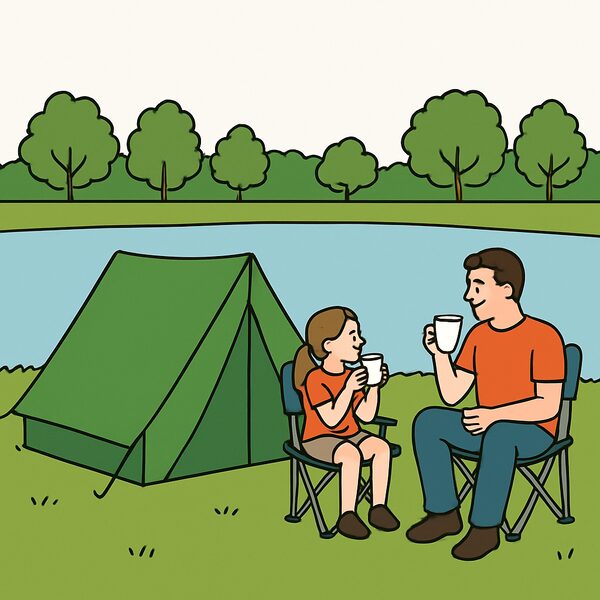
Here are some pictures that show different holidays.
Do you like these different holidays? Say why or why not. I’ll say that again.
Do you like these different holidays? Say why or why not.
All right? Now, talk together.
(Allow the candidates to talk for 1–2 minutes.)
Do you think … a camping holiday is fun? … a holiday in a big city is interesting? … a beach holiday is boring? … a holiday on a ship is expensive? … a walking holiday in the mountains is tiring? (Ask each candidate at least one question. Optional prompts: Why? / Why not? What do you think?)
So, A, which of these holidays do you like best?
And you, B, which of these holidays do you like best?
Thank you. (Can I have the booklet, please?)
Phase 2 (up to 2 minutes)
Now, do you prefer going on holiday with friends or with family, B? (Why?)
And what about you, A? (Do you prefer going on holiday with friends or with family?) (Why?)
Do you prefer holidays in your country or in another country, A? (Why?)
And you, B? (Do you prefer holidays in your country or in another country?) (Why?)
Thank you. That is the end of the test.
Sample answer
Model answer — Part 2 (discussion)
Examiner: Now, in this part of the test you are going to talk together. Here are some pictures that show different holidays. Do you like these different holidays? Say why or why not. I’ll say that again. Do you like these different holidays? Say why or why not. All right? Now, talk together.
Candidate A: OK. I really like this one, the beach holiday. It’s very relaxing, and I love swimming in the sea. What about you?
Candidate B: Hmm, I don’t like beach holidays very much. It’s too hot for me, and after one day I’m bored. I prefer the mountains. I like walking, and the air is very fresh.
Candidate A: Yes, walking in the mountains is nice, but I think it’s very tiring. Do you like camping?
Candidate B: Yes, I do. When I was a child, I went camping with my family every summer. It’s cheap, and you can sleep next to a lake or a river.
Candidate A: Really? I don’t like camping. I can’t sleep well in a tent, and sometimes it rains. I prefer a hotel!
Candidate B: And this one, the holiday in the city? I like visiting big cities, because there are lots of museums and restaurants.
Candidate A: Me too. I went to Rome last year, and it was wonderful. But cities are very busy, and the hotels are expensive.
Candidate B: That’s true. And what about the ship? Would you like a holiday on a ship?
Candidate A: No, I don’t think so. I think it’s boring to stay on a ship for a long time.
Candidate B: I agree. And I don’t like the sea when there are big waves!
Examiner: Carla, do you think a camping holiday is fun?
Candidate A: Not for me, because I like to be comfortable. But I think it’s fun for children.
Examiner: Tomasz, do you think a holiday on a ship is expensive?
Candidate B: Yes, I think it’s very expensive. You pay for the ship, the food and the trips, so it’s a lot of money.
Examiner: So, Carla, which of these holidays do you like best?
Candidate A: I like the beach holiday best, because I can relax and swim.
Examiner: And you, Tomasz, which of these holidays do you like best?
Candidate B: The mountains, because I love walking and it’s very quiet there.
Examiner: Thank you. Now, do you prefer going on holiday with friends or with family, Tomasz?
Candidate B: With my family. We always go away together in August.
Examiner: Why?
Candidate B: Because it’s the only time we are all together for two weeks, with no work and no school.
Examiner: And what about you, Carla?
Candidate A: With friends, I think. My parents like quiet holidays, but my friends and I like going out and seeing new places.
Examiner: Do you prefer holidays in your country or in another country, Carla?
Candidate A: In another country. I like hearing different languages and trying new food.
Examiner: And you, Tomasz?
Candidate B: In my country, because it’s easier and cheaper to travel. And there are a lot of beautiful places that I haven’t visited yet.
Examiner: Thank you. That is the end of the test.
The candidates talk to each other, not to the examiner: they ask questions (“What about you?”, “Do you like camping?”), agree and disagree politely (“Me too”, “That’s true”, “Really? I don’t like camping”) and talk about all five pictures, which earns high marks for Interactive Communication. Every opinion comes with a simple reason, which is exactly what the task asks for. Grammar and Vocabulary is strong for A2: simple tenses are accurate, there is useful topic vocabulary (tent, waves, relaxing, tiring) and “would you like” and “prefer” are used correctly. The answers are short and simple in places, as expected at this level, but they keep the conversation going without help from the examiner.
B1 Preliminary (B1). Part 1, Part 2, Part 3, Part 4 of the Speaking paper. Timing on the real exam — Speaking: 10-12 minutes per pair.
Tip: Answer the question, then add one more thing: a reason, an example or a detail. Two or three sentences is enough; don’t give a prepared speech, because the examiner may ask something different.
The examiner asks each candidate questions in turn about personal information, daily life, likes and dislikes. The candidates do not talk to each other in this part. (About 2 minutes)
Examiner
Good afternoon. Can I have your mark sheets, please?
I’m Martin, and this is my colleague, Helen.
(To Candidate A) What’s your name? Where do you live?
Thank you.
(To Candidate B) And what’s your name? Where do you live?
Thank you.
B, do you work or are you a student? What do you do? / What do you study?
Thank you.
And A, do you work or are you a student? What do you do? / What do you study?
Thank you.
(Ask each candidate one or more of these questions.)
What do you enjoy doing in the evenings? (Why?)
Tell us about a place in your town that you like.
How often do you cook for other people?
What did you do last summer?
Do you think you’ll live in the same town in five years’ time? (Why? / Why not?)
Thank you.
Sample answer
Sample answer — Part 1
Examiner: Good afternoon. Can I have your mark sheets, please? Thank you. I’m Martin, and this is my colleague, Helen. What’s your name?
Candidate A: My name is Elena.
Examiner: Where do you live, Elena?
Candidate A: I live in Valencia, in Spain, but at the moment I’m staying in Brighton for three months to improve my English.
Examiner: Thank you. And what’s your name?
Candidate B: I’m Tomasz.
Examiner: Where do you live, Tomasz?
Candidate B: I live in a small town near Gdańsk, in the north of Poland. It’s quite close to the sea.
Examiner: Thank you. Tomasz, do you work or are you a student?
Candidate B: I work. I’m a nurse in a hospital, in the department for children.
Examiner: Thank you. And Elena, do you work or are you a student?
Candidate A: I’m a student. I study architecture at university. It’s my third year, so it’s quite hard now, but I love it.
Examiner: Thank you. Elena, what do you enjoy doing in the evenings?
Candidate A: Well, it depends. On weekdays I usually stay at home, because I’m tired after my classes, so I watch series or I call my family. But on Friday I often go out with my friends – we go for dinner, or to a concert if there is a good one.
Examiner: Tomasz, tell us about a place in your town that you like.
Candidate B: There is a small park next to the river, not far from my flat. It’s very quiet, and in summer I go there after the work to run, or just to sit and read. I think it’s the best place to relax after a long day at the hospital, because nobody is in a hurry there.
Examiner: Elena, how often do you cook for other people?
Candidate A: Not very often, to be honest! My flatmate is a much better cook than me. But sometimes on Sunday I make paella for everyone, because it’s a typical dish from my region and they always ask me for it.
Examiner: Tomasz, what did you do last summer?
Candidate B: Last summer I went camping with my brother in the mountains for one week. We walked a lot every day, and one night there was a terrible storm, so we had to sleep in the car! But it was a great holiday.
Examiner: Thank you.
Both candidates go beyond one-word answers and add a reason or an example each time (“because I’m tired after my classes”, “so we had to sleep in the car”), which is what Discourse Management rewards at B1. Grammar and Vocabulary: simple forms are well controlled, with some more complex ones (“a much better cook than me”, “if there is a good one”); small slips such as “after the work” don’t cause any difficulty. Both are easy to understand, with natural stress and intonation, so Pronunciation is not a problem. This kind of relaxed, extended answer supports a high Global Achievement mark from the interlocutor.
Tip: Start with the general situation, then describe the people, what they are doing and the place. If you don’t know a word, explain it with other words and keep going; use “maybe”, “I think” and “it looks like” to guess.
Each candidate talks on their own for about a minute about a colour photograph. The other candidate listens. (About 3 minutes)
Examiner
Now I’d like each of you to talk on your own about something. I’m going to give each of you a photograph and I’d like you to talk about it.
A, here is your photograph. It shows people repairing a bicycle.
B, you just listen.
A, please tell us what you can see in the photograph.
(Candidate A, about 1 minute. Back-up prompts: Talk about the people. Talk about the place. Talk about other things in the photograph.)
Thank you.
B, here is your photograph. It shows people cooking together.
A, you just listen.
B, please tell us what you can see in the photograph.
(Candidate B, about 1 minute. Back-up prompts as above.)
Thank you.


Sample answer
Sample answer — Part 2
Examiner: A, here is your photograph. It shows people repairing a bicycle. B, you just listen. A, please tell us what you can see in the photograph.
Candidate A: OK. In this photo I can see two people, a man and a girl, and they are repairing a bike together. I think maybe he is her father, or her grandfather, because he looks about fifty years old. The bike is blue and it’s upside down, so they can work on it more easily. The girl is holding the back wheel and she is smiling, so I think she’s enjoying it. The man is kneeling on the ground and he’s using a small tool – I don’t know the word in English – maybe he’s fixing the chain. Next to them there is an open box with tools, and there’s a pump on the grass. They are outside a house: behind them I can see a garage with the door open, and a green hedge. It looks like a sunny afternoon. I like this photo, because the father is teaching his daughter something useful.
Examiner: Thank you. B, here is your photograph. It shows people cooking together. A, you just listen. B, please tell us what you can see in the photograph.
Candidate B: In my photograph there are four young people in a kitchen. I think they are friends, and they are preparing a meal together, maybe for a party or just for dinner. The kitchen is quite small but very bright, with white cupboards. On the left there is a woman with long dark hair, and she’s cutting some vegetables – red peppers and tomatoes, I think – on a wooden board. Next to her, a man with a beard is cooking something in a big pan, and there is steam coming out, so it’s hot. Behind them, another woman is washing lettuce in the sink, and she’s laughing – maybe somebody told a joke. The fourth person is putting plates on a small table, so I suppose they are going to eat soon. There are some plants on the window, and the light looks like evening. Everybody looks relaxed and happy.
Examiner: Thank you.
Both candidates keep talking for about a minute and cover the people, the place and other details without prompting, which earns good marks for Discourse Management. They use a useful range of language for describing and guessing (“I think maybe he is her father”, “so I suppose they are going to eat soon”, “it looks like”), and present continuous forms are accurate. Candidate A deals well with a missing word by paraphrasing (“a small tool – I don’t know the word in English”), which is exactly what examiners want to see at B1. Small errors such as “on the window” for “on the windowsill” do not affect communication.
Tip: Talk about each picture and give a reason, then ask your partner what they think. Don’t agree too quickly: you get marks for how you discuss, not for the final decision, and it doesn’t matter if the examiner stops you before you finish.
The examiner describes a situation and gives the candidates some pictures. The candidates talk together, make and respond to suggestions, and try to agree. (About 4 minutes)
Examiner
Now, in this part of the test you’re going to talk about something together for about two minutes. I’m going to describe a situation to you.
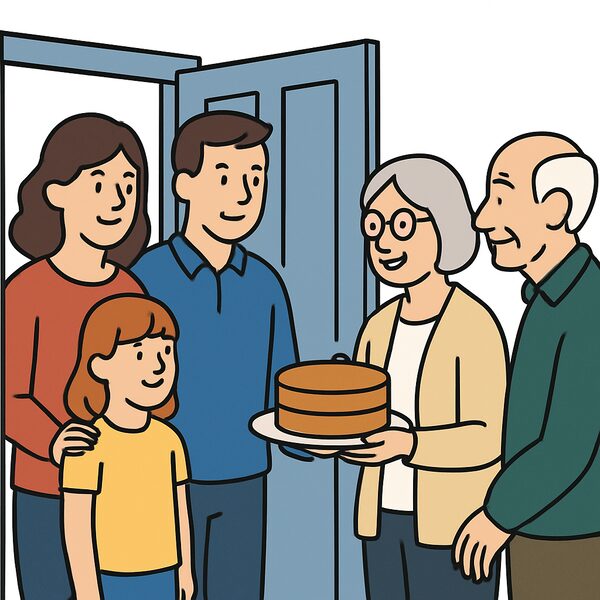
A family has just moved to a new town. They don’t know anyone there, and they would like to meet people.
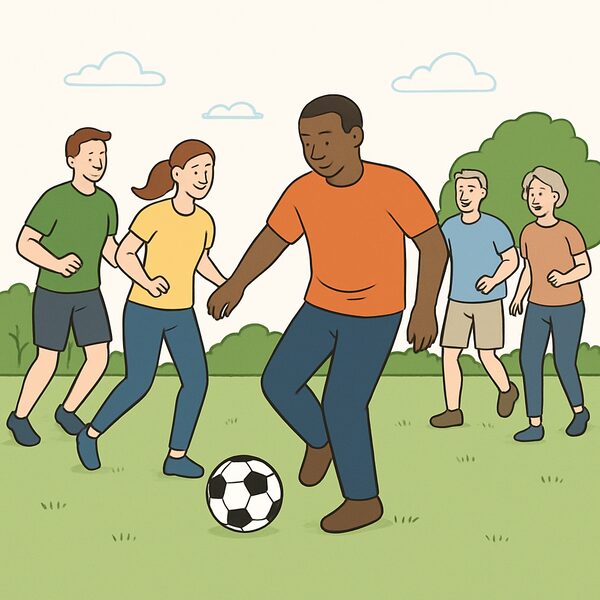
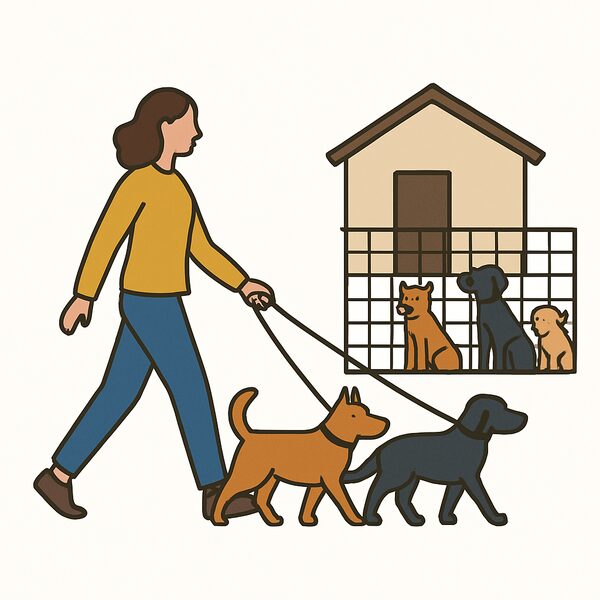
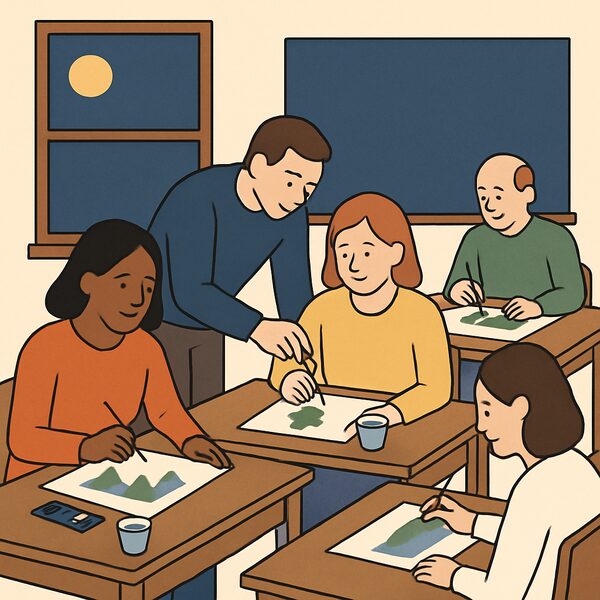
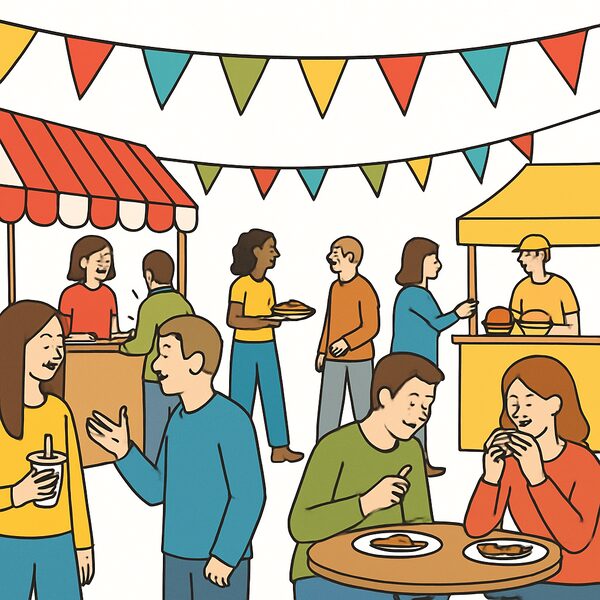
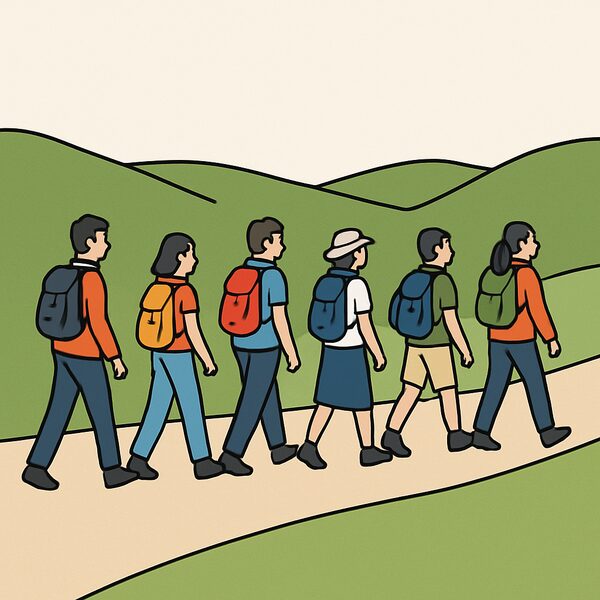
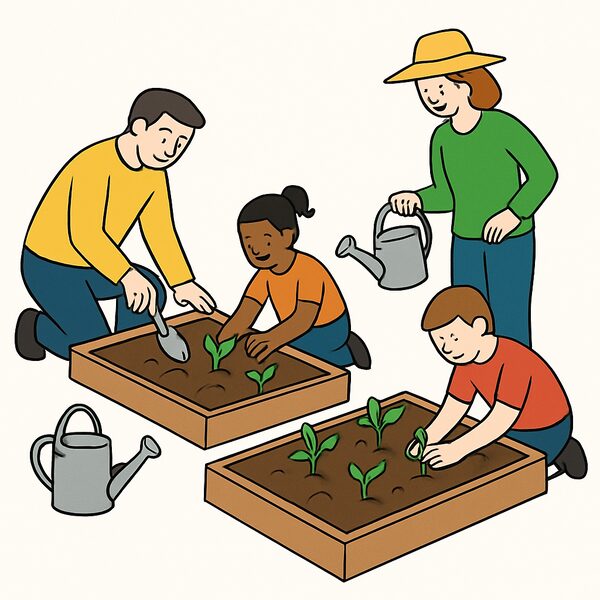
Here are some things they could do to meet people.
Talk together about the different things the family could do, and say which would be the best way to meet people.
All right? Now, talk together.
(Candidates, about 2–3 minutes)
Thank you.
Sample answer
Sample answer — Part 3
Candidate A: So, shall I start? I think joining a sports team is a good idea, because when you play football together you talk a lot, and you become friends quickly.
Candidate B: Yes, I agree, but maybe not for everybody in the family. If the parents don’t like sport, it’s not so easy for them. What about the animal shelter? Walking the dogs could be nice.
Candidate A: Mm, it’s useful, and you help the animals. But I’m not sure you meet many people there. Maybe you spend more time with dogs than with people!
Candidate B: That’s true! OK, what do you think about inviting the neighbours for dinner?
Candidate A: I think it’s a really nice idea, because the neighbours live next to you, so you can see them every day. But some people are shy, and they don’t want to invite people they don’t know into their house.
Candidate B: Yes, the first time is a bit difficult. How about the evening class? For example, a painting class. Everyone in the class is new, so it’s easier to start a conversation.
Candidate A: Exactly. And you go every week, so you see the same people again and again. And the festival?
Candidate B: A street festival is fun, and there are a lot of people. But I think you meet people only one time, and then you never see them again.
Candidate A: I agree. For me, the walking group is similar to the evening class. You walk for two or three hours, so there is a lot of time to talk.
Candidate B: And usually it’s free. The community garden is good too, because the whole family can go – the children can help with planting.
Candidate A: Right, that’s a good point. So which one do you think is the best?
Candidate B: For me, the community garden, because everybody in the family can do it together, and you meet people who live in your area.
Candidate A: Hmm, the walking group is also very good, but I agree with you – the garden is better for a family, because maybe the walks are too long for small children.
Candidate B: OK, so we agree – the community garden.
Examiner: Thank you.
This is a strong B1 performance for Interactive Communication: the candidates take turns naturally, ask each other’s opinion (“what do you think about…?”, “So which one do you think is the best?”) and build on each other’s ideas before reaching an agreement. They talk about every picture instead of deciding too quickly. The language of suggesting, agreeing and disagreeing is varied (“What about…?”, “How about…?”, “That’s true”, “I’m not sure”, “that’s a good point”), and every idea comes with a reason, which supports Discourse Management. Minor errors (“you meet people only one time”) don’t prevent communication.
Tip: Treat each question as a small conversation: give your opinion, say why, and add an example from your own life. If the examiner asks your partner, listen, because you may be asked whether you agree.
The examiner asks questions related to the topic of Part 3. The candidates answer and can also respond to each other. (About 3 minutes)
Examiner
(Use the following questions, as appropriate.)
Do you know your neighbours well? (Why? / Why not?)
Is it easy to make friends when you move to a new place? (Why? / Why not?)
Would you prefer to live in a small town or a big city? (Why?)
Do you think it’s better to have a few close friends or lots of friends? (Why?)
What do people in your country do to welcome new neighbours?
(Select any of the following prompts, as appropriate: How / What about you? Do you agree? What do you think?)
Thank you. That is the end of the test.
Sample answer
Sample answer — Part 4
Examiner: Elena, do you know your neighbours well?
Candidate A: Not really. In Valencia I live in a big building with maybe forty flats, and everyone is very busy. I say hello in the lift, but I don’t know their names. In my grandmother’s village it’s completely different – everybody knows everybody.
Examiner: What about you, Tomasz?
Candidate B: I know some of them. There is an old lady next door – sometimes I help her to carry her shopping, and at Christmas she made a cake for me. So yes, I think we are a little bit friends.
Examiner: Tomasz, is it easy to make friends when you move to a new place?
Candidate B: I think it depends on your age. When you are a child it’s easy, because you go to school and you meet other children every day. But for adults it’s harder. You go to work, you come home, you are tired. When I moved to my town, it took almost a year before I had good friends there.
Examiner: Do you agree, Elena?
Candidate A: Yes, I agree. When I came to Brighton, for the first two weeks I felt quite lonely. But in my English school there are students from many countries, and everybody is in the same situation, so we started to go out together. Now I have friends from Japan, Brazil, Italy…
Examiner: Elena, would you prefer to live in a small town or a big city?
Candidate A: At the moment, a big city, because there are more things to do, and more jobs for architects. But maybe when I’m older and I have children, I will prefer a small town, because it’s safer and quieter.
Examiner: And Tomasz, do you think it’s better to have a few close friends or lots of friends?
Candidate B: For me, a few close friends is better. My best friend – I know him since we were six years old – and I can tell him anything. With a big group of friends it’s fun for parties, but it’s not the same.
Candidate A: I think the same, but it’s also nice to have different friends for different things – for example, some friends for sport and some for going out.
Examiner: Thank you. That is the end of the test.
The candidates give full, personal answers with reasons and examples, contrasting ideas with “but” and “it depends”, which shows good Discourse Management for B1. Elena joins in with Tomasz’s answer without being asked (“I think the same, but…”), which is rewarded under Interactive Communication. Grammar and Vocabulary: there is a good range for familiar topics, including comparatives and a conditional idea (“when I’m older and I have children”). Typical B1 errors (“I know him since we were six”, “I will prefer”, “we are a little bit friends”) are noticeable but never stop the listener understanding.
B2 First (B2). Part 1, Part 2, Part 3, Part 4 of the Speaking paper. Timing on the real exam — Speaking: 14 minutes per pair.
Tip: Give a full answer with a reason or an example, but don’t prepare a speech: two to four natural sentences per question is about right.
Part 1 (about 2 minutes). The examiner asks each of you some questions about yourself, such as where you live, your free time and your plans. You answer the examiner; you do not talk to your partner in this part.
Examiner
Good morning. My name is David, and this is my colleague, Helen.
And your names are?
Can I have your mark sheets, please? Thank you.
Where do you live, (Candidate A)?
And you, (Candidate B)?
First, we’d like to know something about you.
Do you prefer spending your free time indoors or outdoors? (Why?)
Tell us about a skill you would like to learn.
What was the last trip you went on? (Where did you stay?)
How important is music in your life? (Why?)
Do you think you will live in the same town or city in the future? (Why? / Why not?)
Thank you.
Sample answer
Sample Part 1 — Part 1 (interview)
Examiner: Good morning. My name is David, and this is my colleague, Helen. And your names are?
Candidate A: I’m Lucía.
Candidate B: My name’s Tomasz.
Examiner: Thank you. Where do you live, Lucía?
Candidate A: I live near Valencia, in Spain – well, in a small town just outside the city, actually.
Examiner: And you, Tomasz?
Candidate B: I’m from Gdańsk, in the north of Poland, but at the moment I’m living in Kraków because of my studies.
Examiner: First, we’d like to know something about you. Tomasz, do you prefer spending your free time indoors or outdoors?
Candidate B: Outdoors, definitely, especially in summer. I go cycling with my friends almost every weekend. In winter it’s more difficult, because it gets dark so early, so then I stay at home more and play board games or watch series. But if I can choose, I prefer to be outside.
Examiner: Lucía, tell us about a skill you would like to learn.
Candidate A: Hmm, I think I would like to learn to play the guitar. My brother plays very well, and when we have family parties he always plays and everybody sings. I tried once to learn from videos, but I gave up after a few weeks because my fingers hurt a lot! Maybe with a real teacher it would be easier.
Examiner: Tomasz, what was the last trip you went on?
Candidate B: The last one was in May. I went with my girlfriend to the mountains, to a small village in the south. We did some hiking, and the weather was not so good – it rained for two days – but we still had a great time.
Examiner: Where did you stay?
Candidate B: In a small guesthouse. The owner was very friendly – she made us a huge breakfast every morning.
Examiner: Lucía, how important is music in your life?
Candidate A: Quite important, I would say. I listen to music practically all the time – when I’m on the bus to university, when I’m studying… Actually, I can’t concentrate without it. But I don’t go to concerts very often, because the tickets have become really expensive.
Examiner: Tomasz, do you think you will live in the same city in the future?
Candidate B: I’m not sure. I really like Kraków, but after I finish my degree I would like to work abroad for a few years, maybe in Ireland, to get some experience. And then, who knows? Maybe I will go back to Gdańsk to be near my family.
Examiner: Thank you.
Grammar and Vocabulary: both candidates use a good range of simple and some complex forms (‘if I can choose, I prefer…’, ‘Maybe with a real teacher it would be easier’) and appropriate everyday vocabulary (‘guesthouse’, ‘gave up’); slips such as ‘I tried once to learn’ and ‘the weather was not so good’ do not affect communication. Discourse Management: answers are extended beyond the minimum with reasons and examples (Tomasz contrasts summer and winter; Lucía explains why she gave up the guitar), and ideas are linked with ‘but’, ‘because’ and ‘Actually’. Pronunciation: the speech is clear, with natural stress on key words. Interactive Communication: both respond promptly and relevantly to each question, and Tomasz answers the examiner’s follow-up question naturally. Global Achievement: responses are relevant and developed, which is exactly what this part rewards.
Tip: Spend no more than about 15 seconds on what the photographs show; use most of your minute to answer the question above them, speculating about both pictures (‘He might…’, ‘It looks as if…’).
Part 2 (about 4 minutes). Each of you talks on your own for about one minute about two photographs, comparing them and answering the question printed above them. After your partner’s long turn, you answer a short question about their photographs in about 30 seconds.
Examiner
In this part of the test, I’m going to give each of you two photographs. I’d like you to talk about your photographs on your own for about a minute, and also to answer a question about your partner’s photographs.
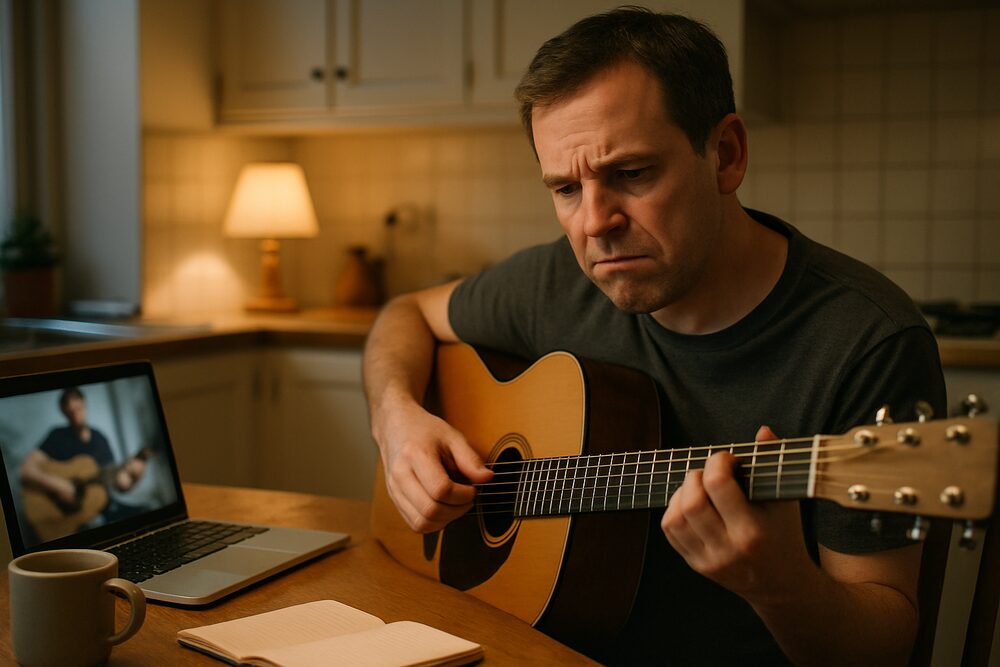
(Candidate A), it’s your turn first. Here are your photographs. They show people learning new skills in different situations. I’d like you to compare the photographs, and say what the people might find difficult about learning in these situations. All right?
[Candidate A: about 1 minute]
Thank you.
(Candidate B), which of these ways of learning would you prefer? (Why?)
[Candidate B: about 30 seconds]
Thank you.
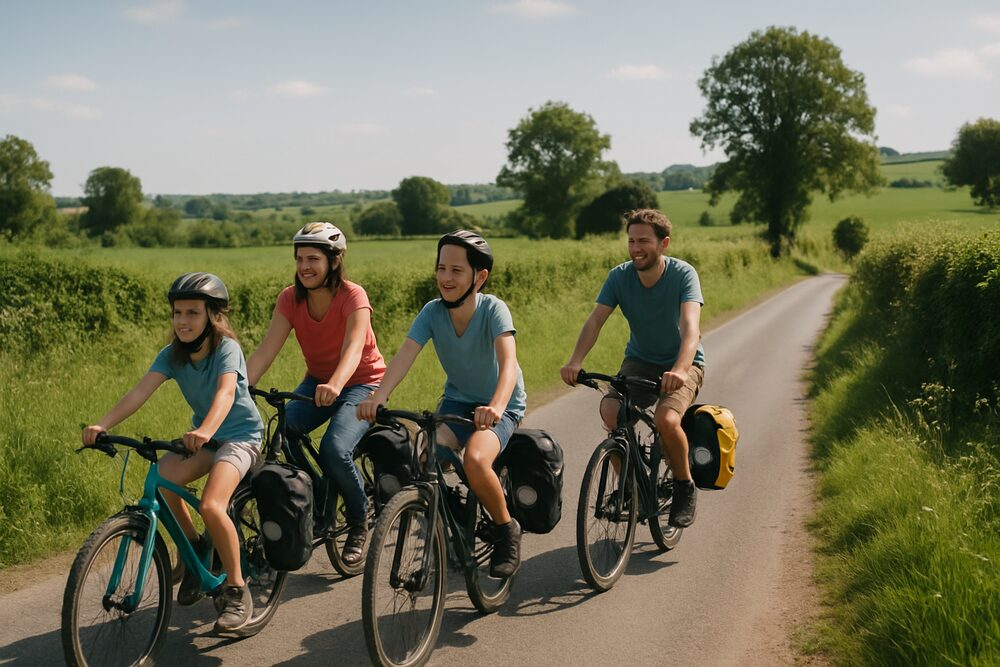
Now, (Candidate B), here are your photographs. They show people travelling in different ways. I’d like you to compare the photographs, and say why the people might have chosen to travel in these ways. All right?
[Candidate B: about 1 minute]
Thank you.
(Candidate A), which of these ways of travelling would you enjoy more? (Why?)
[Candidate A: about 30 seconds]
Thank you.
Candidate A
What might the people find difficult about learning in these situations?

Candidate B
Why might the people have chosen to travel in these ways?

Sample answer
Sample Part 2 — Part 2 (long turn)
Examiner: In this part of the test, I’m going to give each of you two photographs. I’d like you to talk about your photographs on your own for about a minute, and also to answer a question about your partner’s photographs. Lucía, it’s your turn first. Here are your photographs. They show people learning new skills in different situations. I’d like you to compare the photographs, and say what the people might find difficult about learning in these situations. All right?
Candidate A: OK. So in both photos people are learning something new, but the situations are quite different. In the first one there’s a man at home, learning to play the guitar – I think he’s following a lesson on his laptop. In the second photo there’s a group of people in a pottery class, with a teacher. I think the man at home might find it difficult because nobody can correct him. If he’s holding the guitar in the wrong way, for example, the video can’t tell him, so he could get bad habits. He also looks a bit frustrated, maybe because he has to stop the video all the time. On the other hand, the people in the pottery class have a teacher who can help them – like the woman whose pot is, er, falling down, I think. For them the difficulty might be that everybody is watching, so if you make a mistake it’s a little bit embarrassing.
Examiner: Thank you. Tomasz, which of these ways of learning would you prefer?
Candidate B: I think I’d prefer the class, like in the second photo. I’m not very disciplined, so when I learn alone at home I usually stop after a few days. With a teacher and other people, you have to go every week, and it’s more fun, too. Although it’s more expensive, of course.
Examiner: Thank you. Now, Tomasz, here are your photographs. They show people travelling in different ways. I’d like you to compare the photographs, and say why the people might have chosen to travel in these ways. All right?
Candidate B: Yes. Both photos show people travelling, but in the first one I think it’s for pleasure, and in the second one it’s probably a daily journey. In the first picture there’s a family riding bikes along a road in the countryside. They have bags on their bikes, so maybe they’re on a cycling holiday. In the second picture, people are on a very crowded train – it looks like the rush hour in a big city. I suppose the family chose to cycle because they want to spend time together and be active, and you can stop wherever you want and enjoy the views. The people on the train, on the other hand, probably don’t have much choice. Maybe driving in the city centre is too slow, or parking is very expensive, so the train is the fastest way to get to work. Although it doesn’t look very comfortable, to be honest – almost everybody is standing.
Examiner: Thank you. Lucía, which of these ways of travelling would you enjoy more?
Candidate A: Oh, cycling, without doubt. I really hate crowded places, and on a train like that you can’t even sit down. But I’m not sure about cycling with all those bags for many days. Maybe for one or two days it would be perfect.
Examiner: Thank you.
Grammar and Vocabulary: both candidates use modals of speculation (‘might find it difficult’, ‘could get bad habits’, ‘probably don’t have much choice’) and a relative clause (‘the woman whose pot is…’), with topic vocabulary such as ‘disciplined’, ‘rush hour’ and ‘cycling holiday’. Lucía’s hesitation over ‘falling down’ is handled well without breaking the flow. Discourse Management: each long turn briefly compares the photographs and then answers the printed question for both, using ‘On the other hand’, ‘Although’ and ‘for example’ to organise the minute; neither candidate simply describes the pictures. Pronunciation: clear and easy to follow, with appropriate intonation when contrasting ideas. Interactive Communication: the 30-second responses answer the question directly and add a reason. Global Achievement: both candidates complete every stage of the task with relevant, extended contributions.
Tip: You don’t need to discuss all five prompts. It’s better to develop a few of them properly, respond to what your partner says and, in the final minute, really try to agree on one answer.
Part 3 (about 4 minutes). You and your partner talk together for about two minutes about a question and five written prompts. Then the examiner asks you to spend about a minute reaching a decision together.
Examiner
Now, I’d like you to talk about something together for about two minutes.
Some people think it’s a good idea for students to have a part-time job while they are studying. Here are some things they think about and a question for you to discuss. First you have some time to look at the task.
[15 seconds]
Now, talk to each other about what the advantages are for students of having a part-time job.
[Candidates: about 2 minutes]
Thank you. Now you have about a minute to decide which of these is the most important advantage for students.
[Candidates: about 1 minute]
Thank you.
Sample answer
Sample Part 3 — Part 3 (collaborative task)
Examiner: Now, I’d like you to talk about something together for about two minutes. Some people think it’s a good idea for students to have a part-time job while they are studying. Here are some things they think about and a question for you to discuss. First you have some time to look at the task.
Examiner: Now, talk to each other about what the advantages are for students of having a part-time job.
Candidate A: Shall I start? So, the first one is earning their own money. I think this is quite obvious – if students have their own money, they don’t need to ask their parents every time they want to go out. What do you think?
Candidate B: Yes, I agree, but I think it’s not only about going out. For a lot of students, especially if they study in another city, like me, the rent is very high, so the money from a job is really necessary, not just for fun.
Candidate A: That’s true, I hadn’t thought about that. What about learning to manage their time?
Candidate B: Well, it’s definitely something you learn. When I started working in a café last year, I had to plan my week very carefully – when to study, when to work… At the beginning it was a disaster, honestly, but now I’m much more organised.
Candidate A: But don’t you think there’s a risk, too? If you work too many hours, your studies can suffer. I have a friend who had to repeat a year because she was working every evening.
Candidate B: Yes, that’s a good point. So maybe it depends on how many hours.
Candidate A: Exactly. Let’s move on to meeting different people. I think that’s a nice advantage, because at university you normally only meet people of the same age, but in a job you meet customers, older colleagues…
Candidate B: Right, and you learn how to talk to people who aren’t your friends, which is important. And this connects with gaining experience for the future, doesn’t it? Because employers want to see that you have worked before, even if it’s in a different area.
Candidate A: Yes, I think employers value that a lot. It shows you’re responsible. And becoming more independent – that’s quite similar to the money point, I suppose.
Candidate B: Partly, but it’s also about confidence – making decisions without asking your parents.
Examiner: Thank you. Now you have about a minute to decide which of these is the most important advantage for students.
Candidate A: OK, so for me it’s between earning money and gaining experience. What’s your opinion?
Candidate B: I would say experience, because the money is important now, but the experience helps you for your whole career.
Candidate A: Hmm, I see what you mean, but some students without money can’t even continue studying. So for them, money is more important.
Candidate B: That’s true… but the question is about students in general, and most students get some help from their families, I think.
Candidate A: OK, fair enough. And experience also includes managing your time and meeting people, in a way. So shall we choose gaining experience for the future?
Candidate B: Yes, let’s go with that.
Examiner: Thank you.
Grammar and Vocabulary: a good range of forms is used with control, including conditionals (‘If you work too many hours, your studies can suffer’), a past perfect (‘I hadn’t thought about that’) and question tags (‘doesn’t it?’), with suitable vocabulary such as ‘organised’, ‘value’ and ‘continue studying’. Discourse Management: contributions are relevant and developed with personal examples (Tomasz’s café job, Lucía’s friend), and the candidates link prompts together (‘this connects with…’, ‘that’s quite similar to the money point’). Pronunciation: intelligible throughout, with appropriate intonation on questions and when disagreeing politely. Interactive Communication: this is the strongest feature: the candidates invite each other’s opinions, build on and challenge what the other says (‘But don’t you think there’s a risk, too?’), and negotiate towards a joint decision instead of simply stating preferences. Global Achievement: the task is fully carried out, several prompts are discussed in depth and a clear decision is reached.
Tip: Treat Part 4 as a conversation: give your opinion with a reason and an example, and don’t wait to be asked before you react to what your partner has said.
Part 4 (about 4 minutes). The examiner asks you both questions related to the topic of Part 3. You give your opinions and can respond to what your partner says.
Examiner
Use the following questions, in order, as appropriate:
Is it better to have a job you enjoy or a job that pays well? (Why?)
Do you think students should be paid when they do work experience? (Why? / Why not?)
How important is it for young people to learn how to manage money? (Why?)
Do you think people will work fewer hours in the future? (Why? / Why not?)
Some people say that young people today have less free time than in the past. Do you agree? (Why? / Why not?)
Should schools teach practical skills for work, such as how to write a CV? (Why? / Why not?)
Select any of the following prompts, as appropriate: What do you think? Do you agree? And you?
Thank you. That is the end of the test.
Sample answer
Sample Part 4 — Part 4 (discussion)
Examiner: Lucía, is it better to have a job you enjoy or a job that pays well?
Candidate A: That’s a difficult question. Ideally both, of course! But if I have to choose, I would say a job you enjoy, because we spend so many hours at work. If you hate what you do, the money doesn’t really make up for it. My father worked for many years in a bank, with a good salary, but he was always stressed and tired. Now he has his own small business and earns less, but he’s much happier.
Examiner: And you, Tomasz?
Candidate B: I mostly agree with Lucía, but I think it depends on the situation. When you’re young and you have to pay rent, or you want to buy a flat, the salary is very important. Maybe later in your life you can choose something you enjoy more.
Candidate A: Yes, but sometimes people wait and wait, and they never change.
Candidate B: That’s true, it’s a risk.
Examiner: Tomasz, do you think students should be paid when they do work experience?
Candidate B: Yes, I think so. Even if they are learning, they are also working, and the company gets something from them. Also, if work experience isn’t paid, only students from rich families can afford to do it, and that’s not fair. In my country there are a lot of unpaid internships, especially in the big cities, and several of my friends couldn’t take them for this reason.
Examiner: What do you think, Lucía?
Candidate A: I agree with Tomasz about it being unfair. But maybe for very short periods, like one or two weeks, it’s OK not to pay, because the company has to spend time teaching the student, and the student can’t do so much useful work yet.
Examiner: Lucía, how important is it for young people to learn how to manage money?
Candidate A: I think it’s extremely important, and it’s something we don’t learn at school at all. When I moved out of my parents’ house, I had no idea how much electricity costs, or how to make a budget. The first few months, I spent almost all my money in the first two weeks! So I think schools should teach this, maybe as part of maths.
Examiner: Do you agree, Tomasz?
Candidate B: Yes, completely. And it’s even more important now, because when you pay with your phone or a card you don’t see the money, so it’s very easy to spend too much without noticing.
Examiner: Tomasz, do you think people will work fewer hours in the future?
Candidate B: Hmm, I’m not sure. In theory, technology should do more of the work, so people could work less, and some companies are already trying a four-day week. But on the other hand, with phones and laptops, many people never really stop working – they answer emails in the evening, at the weekend…
Candidate A: Yes, exactly. The line between work and free time is disappearing.
Candidate B: So maybe fewer hours in the office, but not less work in total.
Examiner: And what do you think, Lucía?
Candidate A: Well, I hope so! I think a four-day week is a great idea, because people who are rested work better. But I don’t think it will be possible in every job – for example in hospitals, or restaurants, where someone always has to be there.
Examiner: Thank you. That is the end of the test.
Grammar and Vocabulary: both candidates use a range of structures to express and justify opinions, such as conditionals, ‘Even if…’ and ‘it depends on the situation’, and topic vocabulary such as ‘unpaid internships’, ‘make a budget’ and ‘four-day week’. Occasional non-standard phrasing (‘The first few months, I spent…’, ‘the student can’t do so much useful work yet’) does not cause any strain. Discourse Management: answers are well developed with reasons and personal examples (Lucía’s father, Tomasz’s friends), and they move beyond simple agreement to qualified positions (‘maybe for very short periods…’, ‘fewer hours in the office, but not less work in total’). Pronunciation: clear, with appropriate sentence stress. Interactive Communication: the candidates react to each other without being prompted (‘Yes, but sometimes people wait and wait…’, ‘Yes, exactly’), which makes this a genuine discussion rather than a series of separate answers. Global Achievement: the candidates handle abstract questions with relevant, extended and well-supported answers.
C1 Advanced (C1). Part 1, Part 2, Part 3, Part 4 of the Speaking paper. Timing on the real exam — Speaking: 15 minutes per pair.
Tip: Give a full answer with a reason or an example, but stop after two or three sentences: Part 1 rewards natural, relevant answers, not memorised speeches.
Part 1 (2 minutes). The interlocutor asks each candidate some questions about themselves, their interests and their experiences. Candidates respond to the interlocutor and do not talk to each other in this part.
Examiner
Good morning. My name is Andrew Hale and this is my colleague, Fiona Marsh.
And your names are?
Can I have your mark sheets, please?
Thank you.
First of all, we’d like to know something about you.
Where are you from?
What do you do there?
How long have you been studying English?
What do you enjoy doing when you want to relax? (Why?)
Is there a skill you’d really like to learn in the next few years? (Why?)
How much has the area where you live changed in recent years?
What’s the best piece of advice anyone has ever given you?
Do you prefer to plan your free time carefully or keep it flexible? (Why?)
If you could spend a year living in another country, where would you choose? (Why?)
Sample answer
Sample answer — Part 1: interview
Examiner: Good morning. My name is Andrew Hale and this is my colleague, Fiona Marsh. And your names are?
Candidate A: I’m Lucía.
Candidate B: Hello, I’m Jonas.
Examiner: Thank you. First of all, we’d like to know something about you. Where are you from, Lucía?
Candidate A: I’m from Valencia, on the east coast of Spain.
Examiner: And you, Jonas?
Candidate B: I’m from a small town near Hamburg, in the north of Germany.
Examiner: Lucía, what do you do there?
Candidate A: I’m in the final year of a degree in architecture, so at the moment most of my life revolves around deadlines, to be honest.
Examiner: Jonas, what do you enjoy doing when you want to relax?
Candidate B: Cycling, mainly. There’s a path along the river near my home, and after a long day at work – I’m a software tester – there’s nothing better than just getting out for an hour. It clears my head in a way that, I don’t know, watching a series never quite does.
Examiner: Lucía, is there a skill you’d really like to learn in the next few years?
Candidate A: Yes, actually, I’d love to learn to sail properly. I’ve been out on boats with friends a few times, but I always end up being the person who just sits there holding a rope. Living by the sea, it seems a bit of a waste not to know how to do it myself.
Examiner: Jonas, how much has the area where you live changed in recent years?
Candidate B: Quite a lot, really. When I was a child it was mostly farmland around the town, but a lot of people who work in Hamburg have moved out there because it’s cheaper, so now there are new housing estates everywhere. It’s livelier than it used to be, although some of the older residents aren’t too happy about the traffic.
Examiner: Lucía, what’s the best piece of advice anyone has ever given you?
Candidate A: Hmm, let me think. Probably something my grandmother used to say, which was roughly, ‘Never decide anything important when you’re hungry or tired.’ It sounds like a joke, but I’ve found it’s surprisingly true. Most of my worst decisions were made at two in the morning!
Examiner: Jonas, do you prefer to plan your free time carefully or keep it flexible?
Candidate B: It depends. During the week I’m quite organised, because otherwise nothing happens, but at weekends I try not to plan too much. Some of the best days I’ve had were ones when I just got on my bike with no particular destination in mind.
Examiner: Thank you.
Both candidates give full, natural answers that go beyond the question without turning into prepared speeches. Grammatical Resource: a good range of forms is used with control, e.g. present perfect for experience (‘I’ve been out on boats’), ‘used to’ for past habits and relative clauses (‘ones when I just got on my bike’). Lexical Resource: idiomatic and precise vocabulary such as ‘revolves around deadlines’, ‘clears my head’ and ‘no particular destination in mind’. Discourse Management: answers are extended with reasons and examples, and contrast is signalled clearly (‘although’, ‘It depends … but’). Pronunciation: the recording models clear stress and intonation, including the contrastive stress needed for ‘During the week … but at weekends’. Interactive Communication: both respond promptly and relevantly and use natural fillers sparingly (‘Hmm, let me think’). Global Achievement: a confident, well-developed performance at C1 level.
Tip: Answer both printed questions for both pictures, and use the pictures as a starting point for speculation (‘he might have been waiting for hours’) rather than simply describing what you can see.
Part 2 (4 minutes). Each candidate is given three photographs and talks about two of them on their own for about a minute, answering the two questions printed above the pictures. The other candidate then answers a short question about their partner’s pictures for about 30 seconds.
Examiner
In this part of the test, I’m going to give each of you three pictures. I’d like you to talk about two of them on your own for about a minute, and also to answer a question briefly about your partner’s pictures.
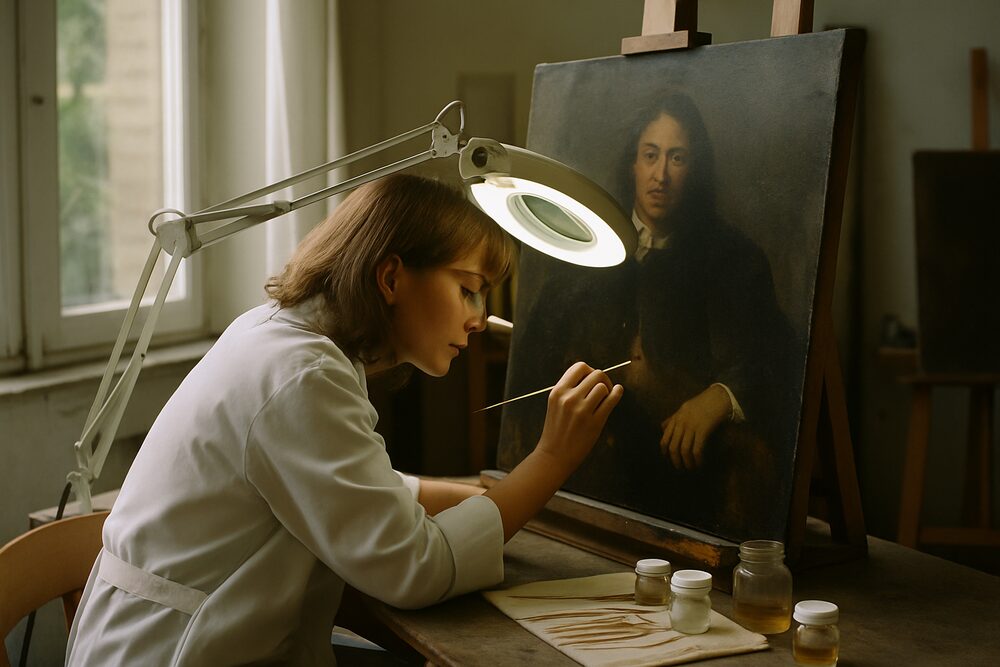
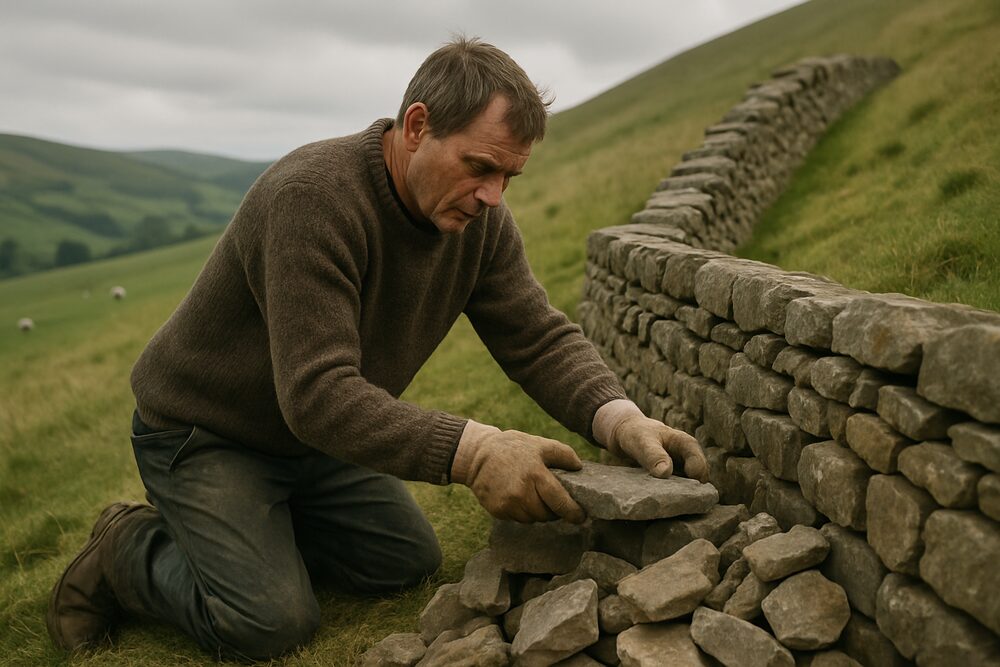
Candidate A, it’s your turn first. Here are your pictures. They show people doing work that requires a lot of patience.
I’d like you to compare two of the pictures, and say why the people might have chosen this kind of work, and how satisfying the work might be.
All right?
[Candidate A: 1 minute]
Thank you.
Candidate B, which of these jobs do you think would require the most patience? (Why?)
[Candidate B: approximately 30 seconds]
Thank you.
Candidate A
Why might the people have chosen this kind of work? How satisfying might the work be?

Examiner
Now, Candidate B, here are your pictures. They show people spending time in busy places.
I’d like you to compare two of the pictures, and say why the people might be in these places, and how they might be feeling.
All right?
[Candidate B: 1 minute]
Thank you.
Candidate A, which of these places would you find the most tiring? (Why?)
[Candidate A: approximately 30 seconds]
Thank you. (Can I have the booklet, please?)
Candidate B
Why might the people be in these places? How might they be feeling?

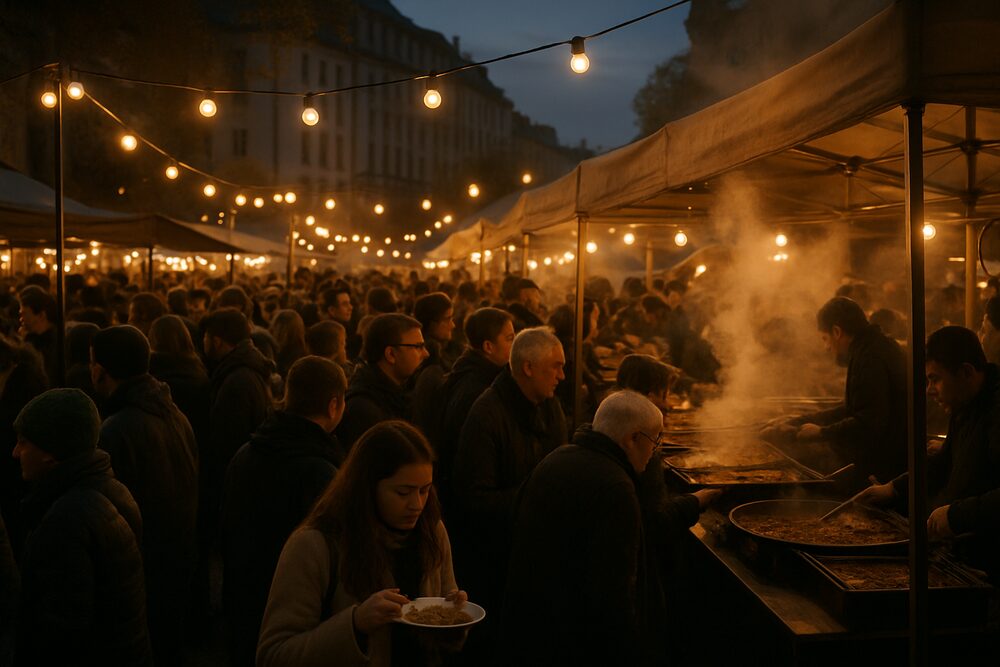
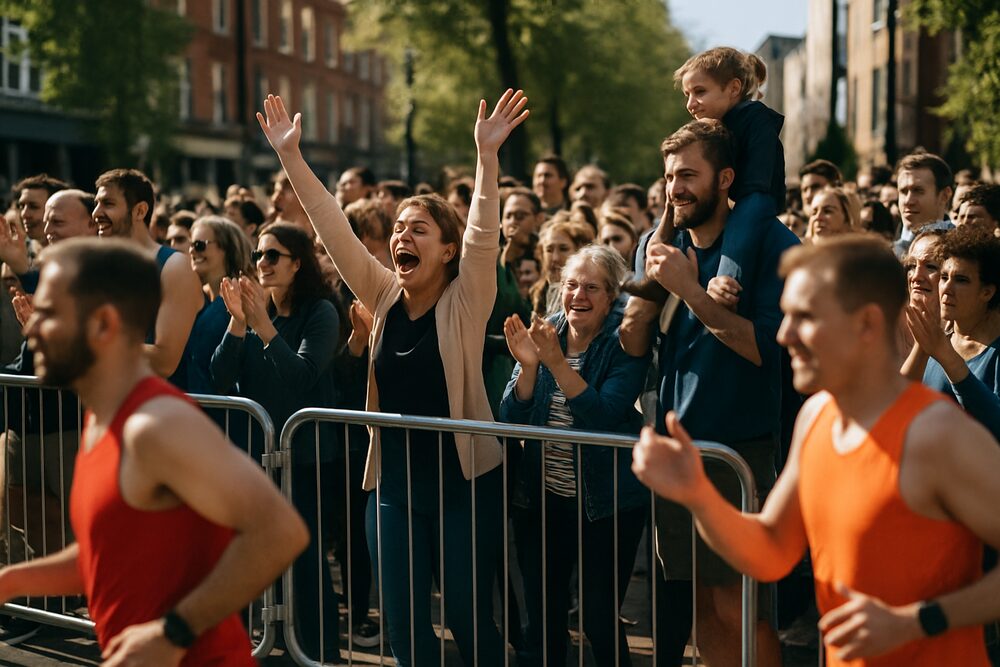
Sample answer
Sample answer — Candidate A’s pictures (patient work)
Examiner: In this part of the test, I’m going to give each of you three pictures. I’d like you to talk about two of them on your own for about a minute, and also to answer a question briefly about your partner’s pictures. Lucía, it’s your turn first. Here are your pictures. They show people doing work that requires a lot of patience. I’d like you to compare two of the pictures, and say why the people might have chosen this kind of work, and how satisfying the work might be. All right?
Candidate A: OK. I’ll talk about the woman restoring the painting and the man photographing wildlife. In the first one, she’s working on what looks like a very old portrait, with a tiny brush and a magnifying lamp, so she’s probably a trained conservator in a museum. I imagine she chose this kind of work because she loves art but perhaps prefers the technical side to actually painting. The photographer, on the other hand, is hidden in some kind of shelter by a lake, and he might have been sitting there for hours just to get one good shot. I suspect he’s someone who feels far more at home outdoors than in an office. As for how satisfying the work is, I’d say both jobs could be incredibly rewarding, but in different ways. For the restorer, the satisfaction probably builds up slowly over weeks or months, whereas for the photographer it comes in a single moment, when the bird finally does something interesting. Although I imagine he also has plenty of days when nothing happens at all, which must be quite frustrating.
Examiner: Thank you. Jonas, which of these jobs do you think would require the most patience?
Candidate B: For me, it would be the man building the wall. The photographer at least has the excitement of not knowing what will turn up, but fitting all those stones together by hand, one after another, in all weathers – that must take an enormous amount of patience. I don’t think I’d last a day, honestly.
Examiner: Thank you.
Lucía addresses both questions for both pictures and goes well beyond description, which is what the task requires. Grammatical Resource: a wide range of structures used accurately for speculation (‘he might have been sitting there for hours’, ‘I suspect he’s someone who …’, ‘I imagine she chose …’). Lexical Resource: precise vocabulary (‘conservator’, ‘the technical side’, ‘feels far more at home outdoors’, ‘incredibly rewarding’). Discourse Management: the long turn is well organised, moving from a clear opening to comparison (‘on the other hand’, ‘whereas’) and a qualified conclusion (‘Although I imagine …’). Pronunciation: the recording shows clear sentence stress on the contrasting ideas (‘slowly over weeks’ / ‘a single moment’). Interactive Communication: Jonas answers his partner’s question directly and justifies his choice by contrasting it with another picture. Global Achievement: both candidates handle the task fully and fluently at C1 level.
Sample answer — Candidate B’s pictures (busy places)
Examiner: Now, Jonas, here are your pictures. They show people spending time in busy places. I’d like you to compare two of the pictures, and say why the people might be in these places, and how they might be feeling. All right?
Candidate B: Right. I’m going to compare the commuters on the platform and the crowd at the marathon. In the first picture it’s obviously rush hour. People are packed together waiting for a train, and most of them are probably on their way to work, so they don’t really have much choice about being there. The people watching the marathon, by contrast, have chosen to be part of a crowd, because they’ve come to support someone, maybe a friend or a relative who’s running. In terms of feelings, I’d imagine the commuters are fairly tense, or perhaps just resigned to it, because it’s something they have to put up with every day. There’s a man checking his watch, so perhaps his train is running late. The spectators, though, look really enthusiastic. They’re clapping and cheering, and even though it’s just as crowded, the atmosphere seems quite joyful. So it’s interesting that being squashed together with strangers can feel completely different depending on why you’re there.
Examiner: Thank you. Lucía, which of these places would you find the most tiring?
Candidate A: Probably the night market, actually. I love the idea of it, all the food and the lights, but it looks so crowded and noisy that after half an hour I think I’d need to escape somewhere quiet. On a train platform at least you know it’s over once you get on.
Examiner: Thank you. Can I have the booklet, please?
Jonas organises his minute around the two questions and ends with an insightful comparison that ties the pictures together. Grammatical Resource: complex sentences with accurate modal and perfect forms (‘they’ve come to support someone’, ‘I’d imagine the commuters are fairly tense’). Lexical Resource: natural collocations and idiomatic phrases (‘packed together’, ‘resigned to it’, ‘put up with’, ‘squashed together with strangers’). Discourse Management: clear signposting (‘In the first picture’, ‘by contrast’, ‘In terms of feelings’, ‘So it’s interesting that …’) keeps the turn coherent and relevant. Pronunciation: the recording models clear chunking of longer sentences and appropriate intonation. Interactive Communication: Lucía responds to the question about her partner’s pictures promptly, choosing a picture Jonas did not discuss and giving a reason. Global Achievement: a fluent, well-structured response that fully meets the task at C1 level.
Tip: You do not need to cover all five prompts. Develop a few ideas properly, react to what your partner actually says, and in the decision phase refer back to points you made together.
Part 3 (4 minutes). The candidates have about 15 seconds to read the task, then discuss the question together for about two minutes using the written prompts. They do not have to talk about all five prompts. The interlocutor then asks them to reach a decision together in about a minute.
Examiner
Now, I’d like you to talk about something together for about two minutes.
Here are some things that can help people feel part of their local community and a question for you to discuss. First you have some time to look at the task.
[Allow 15 seconds.]
Now, talk to each other about how these things might help people feel part of their local community.
[Candidates: 2 minutes]
Thank you. Now you have about a minute to decide which two of these things would do most to bring people of different ages together.
[Candidates: 1 minute]
Thank you. (Can I have the booklet, please?)
Sample answer
Sample answer — Part 3: discussion and decision
Examiner: Now, talk to each other about how these things might help people feel part of their local community.
Candidate A: Shall we start with the street market? I think that’s quite an obvious one, because it gets people out of their houses and into the same place every week.
Candidate B: Yes, and it’s not only about shopping, is it? You tend to see the same stallholders and the same neighbours, so over time you build up these small, casual relationships. I think that’s often underestimated.
Candidate A: Absolutely. Although I suppose it depends on whether people can afford to shop there. In some places markets have become rather expensive, and then they’re more for tourists than for local people.
Candidate B: That’s a fair point. What about shared green spaces? For me that might be even more important, because a park is free and it doesn’t exclude anyone.
Candidate A: I agree, and it’s one of the few places where you see all ages together – parents with toddlers, teenagers, older people walking their dogs. But does being in the same park really make people feel connected? You can sit on a bench for an hour without speaking to a soul.
Candidate B: Hmm, true, unless there’s something organised there. Which maybe brings us to neighbourhood festivals.
Candidate A: Right. I think festivals are brilliant for creating a sense of identity. You feel proud of where you live. The problem is that they only happen once or twice a year, so the effect might not last very long.
Candidate B: Whereas a community centre is there all year round. You could have language classes, a youth club, activities for elderly people …
Candidate A: Yes, it gives people a reason to keep coming back. What do you think about local online groups? I have to say I’m a bit sceptical about those.
Candidate B: Really? I’d say they can be quite useful, actually. In my town people use them to find a lost cat or to borrow a ladder. It’s very practical help.
Candidate A: I see what you mean, but I’ve also seen them turn into places where people just complain about parking.
Candidate B: That’s true as well.
Examiner: Thank you. Now you have about a minute to decide which two of these things would do most to bring people of different ages together.
Candidate B: Well, I think we both agreed that green spaces are good for that, didn’t we?
Candidate A: We did, yes. So shall we choose that as one of them?
Candidate B: I think so. For the second one, I’d be inclined to go for the community centre, because you can deliberately plan activities that mix the generations, like teenagers helping older people with their phones.
Candidate A: Hmm, I was going to suggest festivals, because they’re fun for everyone. But you’re right that they’re not regular enough. And actually, at a festival families mostly stay in their own groups, so it doesn’t really get people talking across the ages.
Candidate B: Exactly. So, green spaces and the community centre?
Candidate A: Yes, let’s go with those two.
Examiner: Thank you. Can I have the booklet, please?
The candidates cover all five prompts, but each one is developed with a reason, a reservation or a reply from the partner rather than simply listed, which is what this part rewards. Interactive Communication: both initiate and respond naturally, invite each other’s views (‘What do you think about …?’, ‘didn’t we?’), build on what the other says and negotiate a decision, with Lucía changing her mind for a stated reason. Discourse Management: contributions are relevant and linked (‘Which maybe brings us to …’, ‘Whereas …’), and the decision phase refers back to points made earlier. Grammatical Resource: complex forms are used with control, including tag questions and conditional ideas (‘unless there’s something organised there’). Lexical Resource: precise and idiomatic vocabulary such as ‘casual relationships’, ‘a sense of identity’, ‘I’d be inclined to go for’ and ‘across the ages’. Pronunciation: the recording models natural intonation for questions, agreement and hesitation. Global Achievement: a balanced, genuinely collaborative performance at C1 level.
Tip: The questions become more abstract as the discussion goes on. Justify your opinion with an example, and when the interlocutor turns to your partner’s view, react to what they said rather than starting a new answer.
Part 4 (5 minutes). The interlocutor leads a discussion on topics related to the Part 3 task. Candidates answer the questions, develop each other’s ideas and agree or disagree with each other.
Examiner
Use the following questions, in order, as appropriate:
Do you think people know their neighbours less well than they used to? (Why? / Why not?)
Some people say that living in a big city can be lonelier than living in a small town. What’s your opinion?
Should local councils spend more money on public spaces such as parks and squares? (Why? / Why not?)
How important is it for young people to do voluntary work in their community? (Why? / Why not?)
Do you think technology has made it easier or harder to build real communities? (Why?)
Whose responsibility is it to make a neighbourhood a welcoming place: individuals or local government? (Why?)
Select any of the following prompts, as appropriate: What do you think? / Do you agree? / How about you?
Thank you. That is the end of the test.
Sample answer
Sample answer — Part 4: discussion
Examiner: Lucía, do you think people know their neighbours less well than they used to?
Candidate A: On the whole, yes, I think so, at least in cities. When my parents were young, people tended to stay in the same neighbourhood for most of their lives, so naturally they knew everyone. Nowadays people move for work or studies every few years, and I think it’s harder to invest in relationships with your neighbours if you know you won’t be there for long. Having said that, in my building we have a group chat, so at least I know people’s names, which is something.
Examiner: Jonas, do you agree?
Candidate B: Partly. I think it depends a lot on the type of place. In my town people still know each other quite well, because the children go to the same schools and you keep seeing the same faces at the supermarket. But I agree that in big apartment blocks you can live next door to someone for years and never have a proper conversation.
Examiner: Some people say that living in a big city can be lonelier than living in a small town. What’s your opinion, Jonas?
Candidate B: I think there’s some truth in it, but it’s also a bit of a cliché. In a small town you might know everybody, but that doesn’t mean you have people you can really talk to. If you’re a bit different from the majority, a small town can actually be quite isolating. In a big city, on the other hand, it’s much easier to find people who share your interests, even if you have to make more of an effort.
Examiner: Lucía?
Candidate A: I’d go along with that. I’d just add that loneliness in a city is perhaps more noticeable. You’re surrounded by thousands of people and you still feel alone, and I think that contrast makes it feel worse.
Examiner: Should local councils spend more money on public spaces such as parks and squares? Lucía?
Candidate A: I’d say yes, definitely, although I realise budgets are limited. Public spaces are one of the few things that benefit absolutely everybody, whatever their income. If you live in a small flat without a balcony, like a lot of students do, the park is effectively your garden. And well-designed squares encourage people to spend time outside, which I think makes a neighbourhood feel safer as well.
Examiner: Jonas?
Candidate B: I agree in principle, but I don’t think it’s only a question of spending more. Sometimes councils create very expensive squares that nobody uses, because there’s no shade or nowhere to sit. It’s more about asking residents what they actually need before anything gets built.
Examiner: How important is it for young people to do voluntary work in their community, Jonas?
Candidate B: I think it’s valuable, but I’m not convinced it should be compulsory, as some people have suggested. When I was at school I helped out at a food bank for a few months, and it really opened my eyes, but I did it because I wanted to. If it’s forced on people, I suspect they just go through the motions.
Examiner: What do you think, Lucía?
Candidate A: I take Jonas’s point, but I’m slightly less against making it part of school life. Some teenagers would never think of volunteering unless someone gave them a bit of a push, and once they try it, they might discover they really enjoy it. Maybe schools could offer a range of options, so that students can choose something they’re genuinely interested in.
Examiner: Do you think technology has made it easier or harder to build real communities? Lucía?
Candidate A: That’s a difficult one. I think it’s made it much easier to start a community – you can find people with the same hobby in minutes – but perhaps harder to keep one going, because online relationships are so easy to walk away from. You can leave a group with one click, whereas if you’re part of a local choir, you feel a sense of obligation to turn up.
Examiner: Jonas?
Candidate B: Yes, I think that’s a really good way of putting it. For me, technology works best when it’s used to organise things that then happen face to face, like the neighbourhood groups we were talking about earlier.
Examiner: Whose responsibility is it to make a neighbourhood a welcoming place: individuals or local government? Jonas?
Candidate B: I’d say both, but if I had to choose, individuals. The council can build a community centre, but it can’t make people say hello to the new family who’ve just moved in next door. It’s those small gestures that really make a place feel welcoming.
Examiner: Lucía, do you agree?
Candidate A: Mostly, yes. Though I’d argue that local government has a role in creating the right conditions. If there are no shared spaces or affordable activities, it’s much harder for individuals to make that effort, however well-meaning they are.
Examiner: Thank you. That is the end of the test.
Both candidates give extended, well-reasoned answers to abstract questions and engage genuinely with each other’s views. Grammatical Resource: a wide range of complex structures is used accurately, including cleft sentences (‘It’s those small gestures that …’), conditionals (‘If it’s forced on people, I suspect …’) and concessive clauses (‘however well-meaning they are’). Lexical Resource: flexible and idiomatic vocabulary (‘invest in relationships’, ‘go through the motions’, ‘a sense of obligation’, ‘creating the right conditions’) conveys precise shades of opinion. Discourse Management: answers are coherent and developed with examples from personal experience, and ideas are linked clearly (‘Having said that’, ‘whereas’, ‘I’d just add that’). Pronunciation: the recording models clear stress and intonation for contrast and emphasis. Interactive Communication: the candidates agree partly, qualify and challenge each other politely (‘I take Jonas’s point, but …’, ‘Mostly, yes. Though I’d argue …’) and refer back to Part 3. Global Achievement: a sophisticated, sustained discussion at a strong C1 level.
C2 Proficiency (C2). Part 1, Part 2, Part 3 of the Speaking paper. Timing on the real exam — Speaking: 16 minutes per pair.
Tip: Give a full, natural answer with a reason or an example, but don’t make a speech: two or three sentences are usually right. A little personal detail or humour is welcome if it comes naturally.
Part 1 (2 minutes). The examiner asks each candidate some questions about themselves. You speak to the examiner, not to your partner.
Examiner
Good morning. My name is David Hart, and this is my colleague, Susan Lane. And your names are?
Could I have your mark sheets, please? Thank you.
First of all, we’d like to know something about you.
Where are you from, (Candidate A)? And you, (Candidate B)?
Are you working or studying at the moment?
(The examiner then asks each candidate one of the following questions.)
What do you find most satisfying about the work or studies you’re doing at the moment?
How important is it to you to live near the place where you grew up?
If you could spend a year learning a completely new skill, what would you choose, and why?
What kind of things do you like to do when you want to switch off from everyday pressures?
How has the way you keep in touch with friends changed over the years?
Is there a place you’ve visited that turned out to be very different from what you’d expected?
Thank you.
Sample answer
Sample answer — Part 1
Examiner: Good morning. My name is David Hart, and this is my colleague, Susan Lane. And your names are?
Candidate A: I’m Sofia Marino.
Candidate B: Tomasz Nowak.
Examiner: Thank you. Could I have your mark sheets, please? Thank you. First of all, we’d like to know something about you. Where are you from, Sofia?
Candidate A: I’m from Turin, in the north of Italy, although I’ve been living in Edinburgh for the past couple of years.
Examiner: And you, Tomasz?
Candidate B: I’m from a small town near Kraków – you probably won’t have heard of it – but I live in Manchester now.
Examiner: Are you working or studying at the moment, Tomasz?
Candidate B: Working. I’m a structural engineer, so I spend most of my time making sure buildings stay up, which is more exciting than it sounds. Sometimes.
Examiner: And you, Sofia?
Candidate A: A bit of both, actually. I’m doing a master’s in public health, and working part-time in a café to keep myself afloat.
Examiner: Sofia, how important is it to you to live near the place where you grew up?
Candidate A: Hmm, that’s an interesting one. When I first left home, I’d have said it didn’t matter at all – I was desperate to get away, to be honest. But the longer I’m away, the more I find myself missing quite specific things, like being able to drop in on my grandmother without planning it weeks in advance. So I suppose it matters more than I expected it to, although I’m not quite ready to move back just yet.
Examiner: Thank you. Tomasz, what kind of things do you like to do when you want to switch off from everyday pressures?
Candidate B: Well, I’m probably a bit of a cliché, but I go climbing – indoors, mostly, because the weather here doesn’t exactly cooperate. The thing is, you physically can’t think about work when you’re halfway up a wall; your whole attention is on where your next hand goes. So it’s a kind of enforced switching off, which I think I need, because otherwise I have a habit of checking emails at midnight.
Examiner: Thank you.
Grammatical Resource: both candidates use complex forms naturally and accurately, such as ‘I’d have said it didn’t matter’ and ‘the longer I’m away, the more I find myself …’. Lexical Resource: idiomatic, precise vocabulary (‘keep myself afloat’, ‘drop in on’, ‘doesn’t exactly cooperate’, ‘enforced switching off’). Discourse Management: answers go well beyond the minimum, with a clear line of thought and a rounded ending (‘So I suppose …’), yet they stay relevant and concise, as Part 1 requires. Pronunciation: sentence stress and intonation carry humour and contrast (‘Sometimes.’). Interactive Communication and Global Achievement: both respond promptly and appropriately to the examiner and handle personal topics with ease and very little hesitation.
Tip: In the first minute, go beyond describing the pictures: speculate about how the people feel and why. In the main task, don’t rush to the decision – discuss several pictures, respond to your partner’s points, and then negotiate a choice together.
Part 2 (4 minutes). You and your partner talk together. First you discuss two of the pictures for about a minute; then you look at all the pictures and do a decision-making task for about three minutes.
Examiner
Now, in this part of the test you’re going to do something together. Here are some pictures showing different ways in which people use public spaces in towns and cities.
First, I’d like you to look at pictures A and D and talk together about what the people might be enjoying about being in these places. You have about a minute for this, so don’t worry if I interrupt you.
(1 minute)
Thank you. Now look at all the pictures. I’d like you to imagine that a magazine is publishing an article about how public spaces can bring different groups of people together. These pictures will be used to illustrate the article.
Talk together about what each picture suggests about the benefits and challenges of sharing public spaces. Then decide which picture should appear on the first page of the article. You have about three minutes to talk about this.
(3 minutes)
Thank you.
Magazine article
Sharing public spaces
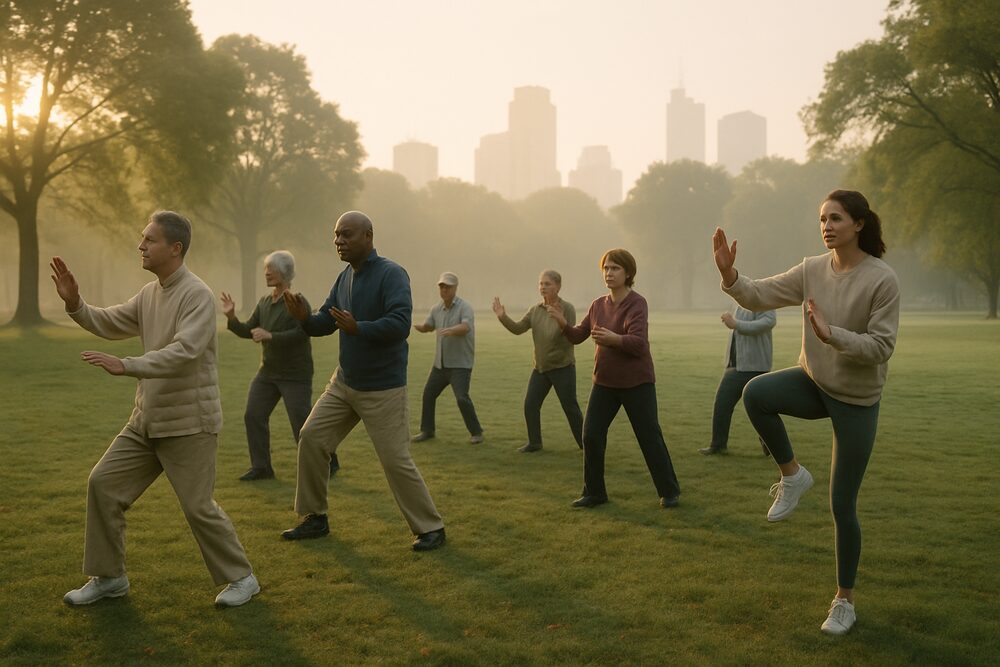
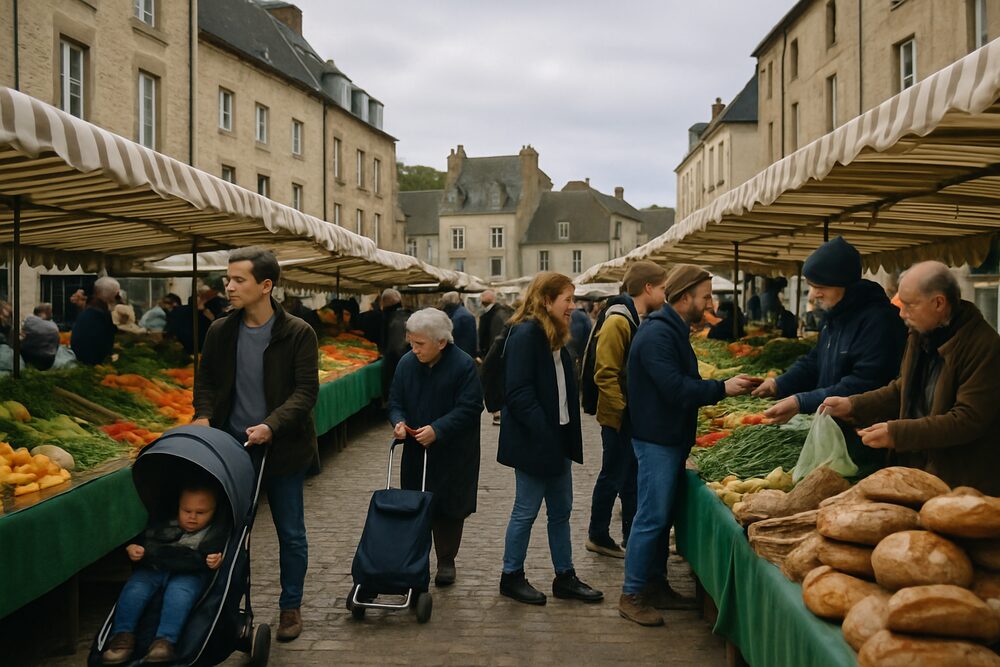
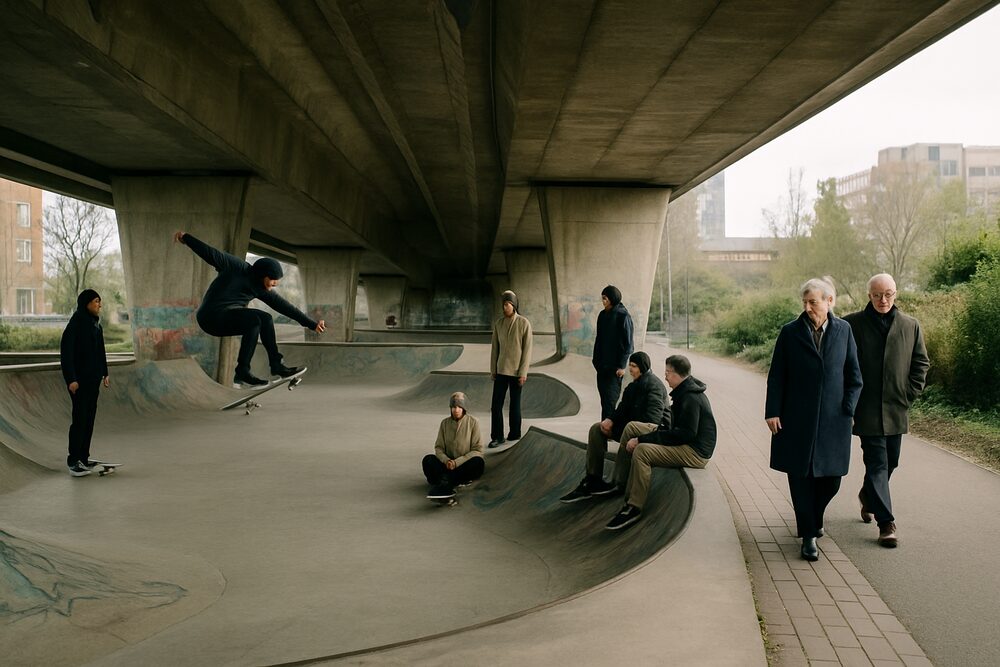


Sample answer
Sample answer — Part 2
Examiner: Now, in this part of the test you’re going to do something together. Here are some pictures showing different ways in which people use public spaces in towns and cities. First, I’d like you to look at pictures A and D and talk together about what the people might be enjoying about being in these places. You have about a minute for this, so don’t worry if I interrupt you.
Candidate A: Shall I start? So in picture A there’s a group doing tai chi in a park, and it looks quite early – the light’s very soft, and there’s hardly anyone else around. I imagine what they’re enjoying is partly the calm before the city wakes up, but also, you know, the fact that they’re doing it together. Nobody seems to be leading in a very formal way.
Candidate B: Yes, and they’re such a mix of ages, which I think is interesting. Most of them look retired, but there’s a young woman at the back who’s clearly concentrating very hard on not losing her balance. Whereas in D, the community garden, I’d say the pleasure is more about, well, making something. Having your hands in the soil when you live on the eighth floor.
Candidate A: Mm, and the company, maybe. I’d guess half the reason that older man is there is to supervise everyone else.
Candidate B: Probably! It must be satisfying, though, watching things actually grow somewhere so built-up.
Examiner: Thank you. Now look at all the pictures. I’d like you to imagine that a magazine is publishing an article about how public spaces can bring different groups of people together. These pictures will be used to illustrate the article. Talk together about what each picture suggests about the benefits and challenges of sharing public spaces. Then decide which picture should appear on the first page of the article. You have about three minutes to talk about this.
Candidate B: OK, maybe we could start with the market, picture B? That seems the most obvious example of a space everyone shares. People come for the same reason, to buy food, and you get all sorts mixing.
Candidate A: True, although I’d question how much they really interact. You go, you buy your tomatoes, you leave. It’s shared, but I’m not sure it brings anyone together in any deeper sense.
Candidate B: That’s fair. The skate park’s a more complicated one, isn’t it? On the one hand, it’s great that teenagers have a space that’s designed for them, rather than being moved on from shopping centres all the time.
Candidate A: Exactly, but you can see the challenge in the picture too. That couple walking past are giving them a pretty wide berth. It sort of illustrates that sharing a space isn’t the same as feeling comfortable in it.
Candidate B: Mm. And the riverside one, E, has the same tension, in a way. The man on the bench presumably wants a bit of peace, and there’s a couple of cyclists going past about a metre from his feet.
Candidate A: Although he doesn’t look remotely bothered. Maybe that’s the point – people can put up with quite a lot if a space is designed well. There’s a strip of grass between the path and the bench, isn’t there?
Candidate B: There is, yes. So I suppose the benefits are clearest in the garden and the tai chi, where people are actually doing something together, and the challenges are clearest where different groups want different things from the same space.
Candidate A: That’s a nice way of putting it. So, for the first page, I’d be tempted by the garden. It’s got the widest range of people, and they’re cooperating rather than just coexisting.
Candidate B: I can see why, but isn’t it a little bit idealised? If the article’s about bringing different groups together, maybe the skate park is more honest – it shows it’s not always easy.
Candidate A: Hmm. But a first page needs to draw people in, and that picture might just put readers off. Whereas the garden makes you ask why there aren’t more places like it.
Candidate B: OK, you’ve convinced me – as long as the skate park goes somewhere inside, to balance things out.
Candidate A: Deal. So we’re agreed on D.
Examiner: Thank you.
Grammatical Resource: a wide range of structures is used flexibly, including speculation (‘I’d guess half the reason …’, ‘must be satisfying’), contrast (‘Whereas’, ‘On the one hand’) and question tags. Lexical Resource: precise, idiomatic language suited to evaluating images (‘giving them a pretty wide berth’, ‘cooperating rather than just coexisting’, ‘idealised’, ‘moved on from shopping centres’). Discourse Management: the one-minute response goes beyond description to speculation, as required, and the decision-making phase moves logically through the pictures before B summarises the benefits and challenges. Interactive Communication: the candidates build on each other’s points, challenge them politely (‘I’d question how much …’, ‘isn’t it a little bit idealised?’) and negotiate a clear outcome with a compromise. Global Achievement: both handle an abstract theme with ease and very little hesitation.
Tip: You don’t have to use all three ideas on the card, and you can add your own. Aim for a short introduction, two or three developed points with examples, and a clear conclusion, and listen closely to your partner, because you will be asked to comment.
Part 3 (10 minutes). Each candidate speaks alone for about two minutes in response to a question card, and the partner comments briefly afterwards. Then the examiner leads a discussion with both candidates on the same topic.
Candidate A
How important is it to have clear goals in life?
Candidate B
Is failure a necessary part of success?
Examiner
Now, in this part of the test you’re each going to talk on your own for about two minutes. You need to listen while your partner is speaking because you’ll be asked to comment afterwards.
So, (Candidate A), I’m going to give you a card with a question written on it and I’d like you to tell us what you think. There are also some ideas on the card for you to use if you like. All right? Here is your card. Please let (Candidate B) see your card. Remember, (Candidate A), you have about two minutes to talk before we join in.
(2 minutes)
Thank you. (Candidate B), do you think it’s better to plan your career carefully or to see what opportunities come along?
(Candidate A), what do you think?
Thank you. Now, (Candidate B), it’s your turn to be given a question. Here is your card. Please let (Candidate A) see your card. Remember, (Candidate B), you have about two minutes to tell us what you think, and there are some ideas on the card for you to use if you like. All right?
(2 minutes)
Thank you. (Candidate A), is it possible to be too afraid of making mistakes?
(Candidate B), what do you think?
Thank you. Now, to finish the test, we’re going to talk about success in general.
Some people say that society measures success too narrowly. What’s your view?
Do you think luck plays a bigger part in success than people like to admit?
Why do you think some people who seem very successful feel dissatisfied?
Should schools put less emphasis on competition between students?
How has the idea of a successful career changed in recent years?
Thank you. That is the end of the test.
Sample answer
Sample answer — Part 3
Examiner: Now, in this part of the test you’re each going to talk on your own for about two minutes. You need to listen while your partner is speaking because you’ll be asked to comment afterwards. So, Sofia, I’m going to give you a card with a question written on it and I’d like you to tell us what you think. There are also some ideas on the card for you to use if you like. All right? Here is your card. Please let Tomasz see your card. Remember, Sofia, you have about two minutes to talk before we join in.
Candidate A: OK. How important is it to have clear goals in life? Well, I think the honest answer is that it depends quite a lot on what we mean by ‘clear’. If we’re talking about having a sense of direction, then I’d say it’s very important, mainly because of motivation. When I decided I wanted to work in public health, it suddenly gave a purpose to things that had felt fairly pointless before – even statistics lectures started to make sense, which is saying something.
Candidate A: On the other hand, I’m a bit wary of goals that are too rigid. I know people who mapped out their whole lives at eighteen – university, job, house by thirty – and when one piece didn’t fall into place, they felt like complete failures, even though by any normal standard they were doing really well. So flexibility matters. A goal should be something that points you in a direction, not a sort of contract you’ve signed with yourself.
Candidate A: And then there’s the question of whose goals they actually are. A lot of what passes for ambition, especially when you’re young, is really other people’s expectations – parents, teachers, even friends, in a way. My cousin trained as a lawyer because that was what the family expected, and he was miserable for years before he could admit it. So I think a clear goal is only really valuable if you’ve chosen it yourself.
Candidate A: So, to sum up, I’d say clear goals are important, but only if they’re genuinely yours, and you’re prepared to revise them when life, inevitably, doesn’t go according to plan.
Examiner: Thank you. Tomasz, do you think it’s better to plan your career carefully or to see what opportunities come along?
Candidate B: For me, a bit of both. I did plan to become an engineer, but the area I specialise in now came about completely by chance, through a summer placement. So I’d say plan the broad outline, and leave room for accidents.
Examiner: Sofia, what do you think?
Candidate A: I agree, actually. Some of the best things that have happened to me are the ones I couldn’t possibly have planned for.
Examiner: Thank you. Now, Tomasz, it’s your turn to be given a question. Here is your card. Please let Sofia see your card. Remember, Tomasz, you have about two minutes to tell us what you think, and there are some ideas on the card for you to use if you like. All right?
Candidate B: Right. Well, I’d like to start by saying that I think it’s almost impossible to succeed at anything difficult without failing along the way – but I’m not sure that makes failure ‘necessary’ in a positive sense.
Candidate B: In my own field, engineering, failure is literally how we learn. Pretty much every building regulation exists because something, somewhere, fell down. And personally, the project I learned most from was one where I made a calculation error early in my career. It was caught before anything was built, thank goodness, but I’ve never checked my work in the same way since. So, yes, mistakes teach you things that success never could.
Candidate B: The problem is that fear of failure can be just as damaging as failure itself. If people are terrified of getting something wrong, they stop taking risks, and they never attempt the thing that might have worked. I think that’s particularly true in education. Where I went to school, the whole system was built around not making mistakes – you lost marks for every little error – and I think a lot of my classmates became very cautious as a result. Whereas I’ve noticed that in some schools now there’s more emphasis on trying things out and reflecting on what went wrong.
Candidate B: Having said that, we shouldn’t romanticise failure either. There’s a fashion for saying ‘fail fast, fail often’, but failing is expensive and painful, especially for people who haven’t got a safety net. It’s easy to celebrate failure when you can afford it. So, overall, I’d say failure is an inevitable part of success, and a valuable one if you learn from it, but I wouldn’t go as far as calling it necessary.
Examiner: Thank you. Sofia, is it possible to be too afraid of making mistakes?
Candidate A: Definitely. I was like that at school – I wouldn’t put my hand up unless I was a hundred per cent sure of the answer. Looking back, I think I missed out on a lot because of it.
Examiner: Tomasz, what do you think?
Candidate B: I think it’s very common. And I like what Sofia said about missing out, because people often don’t notice what fear costs them – it’s all things that never happened.
Examiner: Thank you. Now, to finish the test, we’re going to talk about success in general. Some people say that society measures success too narrowly. What’s your view?
Candidate A: I’d agree with that, to a large extent. We still tend to judge people by their job title and their salary, and it’s much harder to put a value on things like bringing up children well or looking after an elderly relative, even though they’re arguably more important.
Candidate B: Yes, although I think that’s slowly changing. Younger people especially seem much more interested in whether their work is meaningful, not just what it pays. The real question is whether that survives once they’ve got a mortgage.
Candidate A: That’s a very engineering answer – test it under load!
Examiner: Do you think luck plays a bigger part in success than people like to admit?
Candidate B: Absolutely. Successful people tend to tell their story as if everything was down to hard work. And hard work obviously matters, but so does being born in the right place, having parents who could support you, meeting the right person at the right moment.
Candidate A: I’d go along with that, but I’d add that luck isn’t completely random. People who put themselves in lots of different situations – who say yes to things – do seem to get ‘lucky’ more often. So to some extent you can improve your chances.
Candidate B: That’s true. Although you need the time and the money to say yes to things in the first place, so we’re back to the luck of your circumstances.
Examiner: Why do you think some people who seem very successful feel dissatisfied?
Candidate A: I think often it’s because they’ve achieved goals that weren’t really theirs – which is what I was saying earlier. You get to the top of the ladder and realise it was leaning against the wrong wall, as the saying goes.
Candidate B: And also, I suppose, success moves the goalposts. Once you’ve got the promotion, it isn’t an achievement any more, it’s just normal, so you start looking for the next thing. It can turn into a kind of treadmill.
Candidate A: Yes, that’s a good image – running flat out and staying exactly where you are.
Examiner: Thank you. That is the end of the test.
Grammatical Resource: both candidates control a wide range of structures with flexibility – conditionals, cleft and relative clauses, modals of speculation and past habit (‘I wouldn’t put my hand up unless …’). Lexical Resource: vocabulary is precise and idiomatic on abstract topics (‘what passes for ambition’, ‘romanticise failure’, ‘a safety net’, ‘moves the goalposts’), and familiar sayings are adapted naturally rather than recited. Discourse Management: each long turn is well organised, with an introduction that questions the terms of the card, balanced development using the prompts selectively, and a clear summing-up; discourse markers such as ‘On the other hand’, ‘Having said that’ and ‘So, overall’ are used effectively. Pronunciation: contrastive stress and intonation (‘not a sort of contract’, ‘I wouldn’t go as far as calling it necessary’) make the speakers’ attitude and humour clear. Interactive Communication: in the follow-ups and discussion the candidates pick up each other’s ideas (‘I like what Sofia said about missing out’, ‘which is what I was saying earlier’), extend and gently challenge them, and widen the scope of the discussion. Global Achievement: both handle complex, abstract ideas with ease, producing extended and coherent discourse with very little hesitation.

Written by Kirill O'Nayd
English test expert and educator at TestSucceed. He has spent years preparing candidates for Cambridge English Qualifications from A2 Key to C2 Proficiency, and taking apart how each paper awards its marks. See all TestSucceed preparation materials.