
Every writing task of every Cambridge exam, with model answers marked on the same subscales examiners use. The compulsory tasks from B2 First upwards also have a weaker answer alongside the strong one: the difference between them shows what each band asks for more clearly than any descriptor.
A2 Key (A2). Part 6, Part 7 of the Reading and Writing paper. Timing on the real exam — Reading and Writing: 60 minutes.
Tip: Write one or two sentences for each of the three points, and tick each point when you have covered it. Start and end the email in a friendly way. You don’t need many more than 25 words, but every point must be there.
Question 31
Question 31
You are moving to a new flat next month. Write an email to your English friend, Robin.
In your email: • say where your new flat is • tell Robin what you like about the flat • ask Robin to help you move.
Write Write 25 words or more..
Model answers
Model answer — Question 31 (email) (51 words, 15/15 marks)
| Subscale | Band |
|---|---|
| Content | 5 / 5 |
| Organisation | 5 / 5 |
| Language | 5 / 5 |
All three points are covered clearly: where the flat is (on Park Road, near the station), what the writer likes (a big kitchen and a balcony) and a request for help with a date. Robin is fully informed. The email has a natural opening and closing, and it uses simple linking words (because, and, too). Vocabulary is everyday and accurate, and simple grammar (present continuous for a plan, “Could you …?”, “I’ll …”) is used with good control.
Tip: Write at least one sentence for each picture, and use the past simple. Words like “then”, “but” and “after that” help the reader follow the story, and a short ending sentence makes it feel finished.
Question 32
Question 32
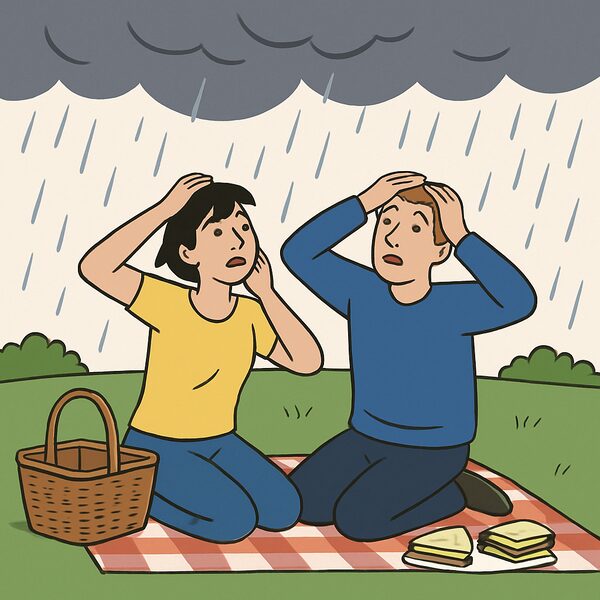
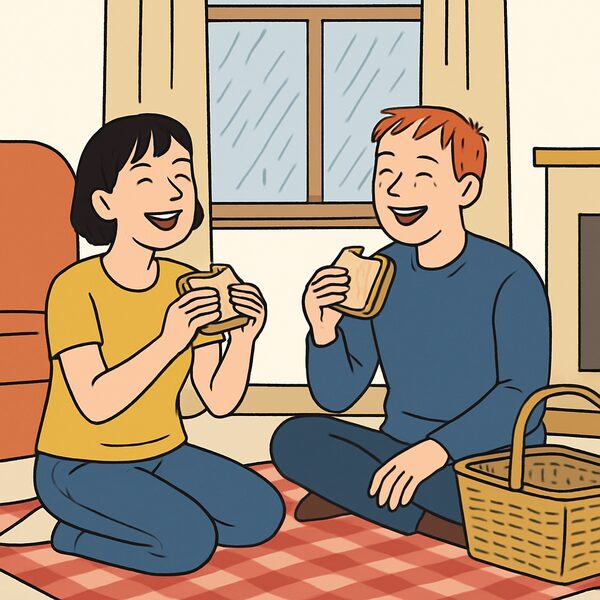
Look at the three pictures. Write the story shown in the pictures.
Write Write 35 words or more..

Model answers
Model answer — Question 32 (story) (57 words, 15/15 marks)
| Subscale | Band |
|---|---|
| Content | 5 / 5 |
| Organisation | 5 / 5 |
| Language | 5 / 5 |
All three pictures are clearly described: the preparation in the kitchen, the rain in the park and the picnic at home, so the reader is fully informed. The story is easy to follow because of basic linking words and time phrases (so, then, but, after ten minutes). Everyday vocabulary (sandwiches, basket, picnic, rain very hard, living room floor) is used correctly, and the past simple is well controlled throughout.
Weaker answer (band 3) — Question 32 (story) (38 words, 9/15 marks)
| Subscale | Band |
|---|---|
| Content | 3 / 5 |
| Organisation | 3 / 5 |
| Language | 3 / 5 |
All three pictures are mentioned, but with little detail: the first is only “make food for picnic”, and the story doesn’t say that they leave the park and go home, so the reader is on the whole informed. The text is connected with basic, high-frequency words (and, after). Basic vocabulary is used reasonably appropriately, but the writer has little control of the past simple (make, go, eat, is), and there are errors with articles, agreement (They was) and spelling (wheather), although the meaning is still mostly clear.
B1 Preliminary (B1). Part 1, Part 2 of the Writing paper. Timing on the real exam — Writing: 45 minutes.
Tip: Make each of the four notes a paragraph and do more than the note asks: if it says “Say which and why”, a reason is needed too. Start and end the email as you would to a friend.
You must answer this question. Write your answer in about 100 words.
Question 1
Read this email from your English-speaking friend Jamie and the notes you have made.
From: Jamie
Subject: River clean-up day
Hi!
I’m organising a day to clean up the path along the river near my flat, and I really hope you can come!
We’re planning to do it on the first or the second Saturday of next month. Which would be better for you?
Afterwards, everyone’s going to have lunch together by the river. What kind of food should people bring?
I’d also like to tell more people about the day. What’s the best way to do that?
Thanks,
Jamie
Write your email to Jamie using all the notes.
Write about 100 words.
Model answers
Model answer — Question 1 (email) (109 words, 19/20 marks)
| Subscale | Band |
|---|---|
| Content | 5 / 5 |
| Communicative Achievement | 5 / 5 |
| Organisation | 5 / 5 |
| Language | 4 / 5 |
All four notes are covered and developed, including a reason for choosing the second Saturday, so Jamie is fully informed. The friendly, enthusiastic tone suits an email to a friend. Each point has its own paragraph, joined with a variety of linking words (because, as, too, also). Everyday vocabulary is used well (easy to share, put up posters) with a range of simple and some complex forms such as “would be better” and “we’ll probably be”, although the language is safe rather than ambitious, which keeps Language at 4.
Weaker answer (band 3) — Question 1 (email) (97 words, 12/20 marks)
| Subscale | Band |
|---|---|
| Content | 3 / 5 |
| Communicative Achievement | 3 / 5 |
| Organisation | 3 / 5 |
| Language | 3 / 5 |
All four notes are mentioned, but the second one is not fully dealt with: the writer says which Saturday but gives no reason, so the reader is only “on the whole informed”. The tone is suitably friendly. The email is organised in paragraphs with basic linking (and, because, also). Errors are noticeable (for you email, very good idea, sandwichs, Everybody like, About tell) and some vocabulary is repeated, but the meaning is always clear, which places Language at band 3.
Tip: Choose the question you have more to say about. For the article, answer every question in the notice and talk to the reader; for the story, keep the same name and person as the first sentence and make sure something happens at the end.
Choose one of these questions. Write your answer in about 100 words.
Question 2
You see this notice on an English-language website.
Articles wanted!
A PLACE I LOVE
Is there a place in your town or city where you really like to spend time? What do you do there, and why is it special to you?
Write an article answering these questions and we will put the best ones on our website!
Write your article.
Write about 100 words.
Question 3
Your English teacher has asked you to write a story.
Your story must begin with this sentence.
When Ella opened the front door, she found a small box with her name on it.
Write your story.
Write about 100 words.
Model answers
Model answer — Question 2 (article) (116 words, 19/20 marks)
| Subscale | Band |
|---|---|
| Content | 5 / 5 |
| Communicative Achievement | 5 / 5 |
| Organisation | 4 / 5 |
| Language | 5 / 5 |
All the questions in the notice are answered fully: the place, what the writer does there and why it matters. The article speaks directly to readers (“If you ever visit…”, “Go and try it!”) and uses a title and a question to hold their attention. Paragraphing is clear, though the linking is mostly simple (but, when, now). Language includes a good range for the level, such as “end up just looking”, “used to take me” and “whenever I feel stressed”, with no errors.
Model answer — Question 3 (story) (110 words, 20/20 marks)
| Subscale | Band |
|---|---|
| Content | 5 / 5 |
| Communicative Achievement | 5 / 5 |
| Organisation | 5 / 5 |
| Language | 5 / 5 |
The story follows on clearly from the opening sentence, explains the box and reaches a satisfying ending, so the task is fully achieved. It builds a little suspense with the note and the locked shed before the surprise, which keeps the reader interested. Events are easy to follow thanks to time expressions (At exactly four, Suddenly). Past tenses are well controlled, including “must have left” and the past perfect “had been so busy” and “had completely forgotten”.
B2 First (B2). Part 1, Part 2 of the Writing paper. Timing on the real exam — Writing: 1 hour 20 minutes.
Tip: Plan one paragraph for each note and one for your own idea, and make sure your introduction and conclusion give a clear answer to the question, not just ‘there are advantages and disadvantages’.
You must answer this question. Write your answer in 140–190 words in an appropriate style.
Question 1
In your English class you have been talking about transport in towns and cities. Now, your English teacher has asked you to write an essay.
Write an essay using all the notes and giving reasons for your point of view.
Should public transport in towns and cities be free for everyone?
Write 140–190 words.
Model answers
Model answer (high band) — Question 1 (essay) (189 words, 20/20 marks)
| Subscale | Band |
|---|---|
| Content | 5 / 5 |
| Communicative Achievement | 5 / 5 |
| Organisation | 5 / 5 |
| Language | 5 / 5 |
Content: both notes are fully developed and the writer adds a clearly relevant own idea (people on low incomes), so the reader is fully informed. Communicative Achievement: the neutral, discursive register suits an essay, and the writer states a balanced opinion in the introduction and returns to it in the conclusion. Organisation: each paragraph has one clear purpose, linked with ‘On the other hand’, ‘A further point’ and ‘In conclusion’, and reference such as ‘This would mean’ connects ideas smoothly. Language: a good range of vocabulary (‘overcrowded’, ‘unreliable’, ‘make a genuine difference’) and grammar (second conditional, ‘there is a real risk that’) is used accurately.
Weaker answer (band 3) — Question 1 (essay) (174 words, 13/20 marks)
| Subscale | Band |
|---|---|
| Content | 4 / 5 |
| Communicative Achievement | 3 / 5 |
| Organisation | 3 / 5 |
| Language | 3 / 5 |
Content: all three points are addressed, including a relevant own idea (crowded buses), so the target reader is informed, although each idea is developed only briefly and the final opinion is vague. Communicative Achievement: the register is suitably neutral, but the opening (‘In this essay I will write my opinion’) and conclusion are formulaic and the argument does not really lead anywhere. Organisation: paragraphing is clear and basic linkers are used (‘First of all’, ‘However’, ‘In conclusion’), but there is little variety in cohesive devices. Language: everyday vocabulary is used appropriately, and alongside simple sentences there are some complex forms (‘people who go to work by car’, ‘which is a big disadvantage’, conditionals); errors with comparatives (‘more clean’), plurals (‘peoples’), prepositions (‘sit in the bus’), spelling (‘goverment’) and phrasing (‘the health of the people’) are noticeable but do not stop the reader understanding.
Tip: Choose the question whose task type you know best, and write for the reader named in it: an article must interest readers, an email must sound like you, and a report needs headings, facts and recommendations.
Write an answer to one of the questions 2–4 in this part. Write your answer in 140–190 words in an appropriate style.
Question 2
You see this announcement in an English-language magazine.
ARTICLES WANTED: A PLACE TO SWITCH OFF
Where do you go in your town or city when you want to relax? What makes this place special, and why might other people enjoy it too?
Write us an article answering these questions. The best articles will appear in next month’s issue.
Write your article.
Write 140–190 words.
Question 3
You have received this email from your English-speaking friend, Jamie.
‘Guess what? I’ve been offered a summer job in a hotel in your country for two months! I’m really excited, but I don’t speak the language. What do you think will be the biggest challenges for me? And what should I do in my free time while I’m there?’
Write your email.
Write 140–190 words.
Question 4
The manager of the sports centre where you are a member wants to attract more people aged 16–25. You have been asked to write a report for the manager. Your report should explain why young people do not use the centre much at the moment and recommend changes that would make it more popular with this age group.
Write your report.
Write 140–190 words.
Model answers
Model answer — Question 2 (article) (190 words, 20/20 marks)
| Subscale | Band |
|---|---|
| Content | 5 / 5 |
| Communicative Achievement | 5 / 5 |
| Organisation | 5 / 5 |
| Language | 5 / 5 |
Content: all three questions are answered in full: where the place is, what makes it special and who else would enjoy it. Communicative Achievement: the eye-catching title, the direct question to the reader and the humorous ending hold the reader’s attention, which is exactly what a magazine article needs. Organisation: the paragraphs move logically from introduction to description, then reasons, then recommendation, with smooth links such as ‘From the street’ and ‘What makes it special, though’. Language: vivid, precise vocabulary (‘walled garden’, ‘dripping’, ‘arguing over crumbs’) and a range of structures, including cleft sentences and ‘whether … or …’, are used with very good control.
Model answer — Question 3 (email) (187 words, 20/20 marks)
| Subscale | Band |
|---|---|
| Content | 5 / 5 |
| Communicative Achievement | 5 / 5 |
| Organisation | 5 / 5 |
| Language | 5 / 5 |
Content: both of Jamie’s questions are answered with relevant, practical detail. Communicative Achievement: the friendly, informal register is consistent throughout (‘fly by’, ‘spoilt for choice’), and the advice is presented in a supportive way that suits a friend. Organisation: each paragraph deals with one of Jamie’s questions, introduced clearly with ‘You asked about …’ and ‘As for …’, and the email opens and closes appropriately. Language: a good range of functional language for advising and recommending (‘It would be a good idea to …’, ‘make sure you …’, ‘I’d also recommend …’) is used accurately, along with conditionals and natural collocations.
Model answer — Question 4 (report) (185 words, 19/20 marks)
| Subscale | Band |
|---|---|
| Content | 5 / 5 |
| Communicative Achievement | 5 / 5 |
| Organisation | 5 / 5 |
| Language | 4 / 5 |
Content: the report explains three clear reasons for the problem and makes a matching recommendation for each, so the manager is fully informed. Communicative Achievement: the neutral, factual tone and the reference to where the information came from are appropriate for a report to a manager. Organisation: clear headings, a stated aim and the sequence ‘Firstly … Secondly … Finally’ make the report very easy to follow. Language: vocabulary is precise and appropriate (‘membership fee’, ‘appeal to’, ‘quieter times of day’) and the grammar is accurate, including a second conditional in the conclusion; the range is good, though slightly less ambitious than it could be.
C1 Advanced (C1). Part 1, Part 2 of the Writing paper. Timing on the real exam — Writing: 1 hour 30 minutes.
Tip: Choose the two points you can argue best, and make the comparison explicit: the task is not just to discuss two ideas but to decide which one would work better, and why.
You must answer this question. Write your answer in 220–260 words in an appropriate style.
Question 1
Your class has attended a panel discussion on what employers can do to help their staff achieve a healthy balance between work and personal life. You have made the notes below.
What can employers do to help staff balance work and personal life?
Notes
• allowing flexible working hours
• limiting work emails outside office hours
• providing facilities at the workplace
Some opinions expressed in the discussion:
‘If people can choose when they start and finish, they can fit work around the rest of their lives.’
‘Answering messages late at night means you never really switch off.’
‘A gym or a crèche at work would save people a lot of time.’
Write an essay for your tutor discussing two of the ways in your notes. You should explain which way would be more effective in helping staff to achieve a healthy balance, giving reasons to support your opinion.
You may, if you wish, make use of the opinions expressed in the discussion, but you should use your own words as far as possible.
Write 220–260 words.
Model answers
Model answer (high band) — Question 1 (essay) (253 words, 20/20 marks)
| Subscale | Band |
|---|---|
| Content | 5 / 5 |
| Communicative Achievement | 5 / 5 |
| Organisation | 5 / 5 |
| Language | 5 / 5 |
Content: two of the three notes are discussed in depth and the essay states clearly which is more effective and why, so the reader is fully informed. Communicative Achievement: the register is consistently neutral and discursive, and ideas from the input are reworked in the writer’s own words rather than copied. Organisation: the argument builds logically, with the third paragraph opening on ‘This is precisely the problem that …’ to link the two points, and the conclusion draws a clear contrast (‘Flexible hours change when people work, whereas …’). Language: a wide range of vocabulary (‘at their disposal’, ‘off duty’, ‘sends a clear signal’) and complex structures such as the cleft sentence in the final line are used accurately and naturally.
Weaker answer (band 3) — Question 1 (essay) (259 words, 12/20 marks)
| Subscale | Band |
|---|---|
| Content | 3 / 5 |
| Communicative Achievement | 3 / 5 |
| Organisation | 3 / 5 |
| Language | 3 / 5 |
Content: two points are discussed and a preference is stated, but the reasons given for it (cost and the number of workers who benefit) say little about which measure would actually improve the balance, and the final sentence drifts towards productivity, so the reader is on the whole informed. Communicative Achievement: the conventions of a discursive essay are used effectively and the neutral register is consistent, but ideas stay fairly straightforward and the comparison is asserted rather than argued. Organisation: the essay is well organised, with a variety of cohesive devices (‘To begin with’, ‘As for’, ‘What is more’, ‘which means’) used to generally good effect, though the paragraphs discuss each point separately and are only linked at the end. Language: there is a range of vocabulary, including some less common items (‘a demanding job’, ‘it must be admitted’), and simple and complex forms such as conditionals and relative clauses are used with control; occasional errors (‘a big difference on’, ‘would not need going’, ‘flexible working hours is’) do not impede communication.
Tip: Choose the question whose reader and purpose you can handle best: a letter to an editor needs a persuasive personal voice, a proposal needs headings and recommendations, and a review must evaluate, not just describe.
Write an answer to one of the questions 2–4 in this part. Write your answer in 220–260 words in an appropriate style.
Question 2
A newspaper article claimed young people are far less interested than previous generations in practical skills such as cooking, sewing and household repairs, blaming busy lifestyles and the low cost of replacing things. You decide to write a letter to the editor.
In your letter, say whether your experience supports the claim, evaluate the reasons given, and suggest how young people could be encouraged to develop practical skills.
Write your letter.
Write 220–260 words.
Question 3
The tourist office in the town where you live wants to attract more visitors outside the busy summer season and has invited residents to submit proposals.
Write a proposal for the tourist office, in which you describe what the town currently offers visitors, suggest two new events or attractions for the quieter months of the year, and explain how local businesses and residents would benefit.
Write your proposal.
Write 220–260 words.
Question 4
A science magazine has invited readers to send in reviews of documentary series which explain a scientific subject to a general audience.
Write a review of a series you have watched, describing what it covers, evaluating how successfully it makes complex ideas easy to understand, and saying whether it would appeal to viewers with no scientific background.
Write your review.
Write 220–260 words.
Model answers
Model answer — Question 2 (letter) (233 words, 20/20 marks)
| Subscale | Band |
|---|---|
| Content | 5 / 5 |
| Communicative Achievement | 5 / 5 |
| Organisation | 5 / 5 |
| Language | 5 / 5 |
Content: all three parts of the task are covered and developed: personal experience, an evaluation of both reasons in the article, and two concrete suggestions. Communicative Achievement: the tone is that of an engaged but courteous reader, persuasive without being aggressive, and letter conventions are handled correctly (‘Dear Sir or Madam … Yours faithfully’). Organisation: each paragraph has a clear function, and phrases such as ‘There is some truth in the claim’, ‘Nor am I convinced’ and ‘What is lacking, in my view’ guide the reader through the argument. Language: precise, natural vocabulary (‘take up a pair of trousers’, ‘far less bleak’, ‘hardly unique to my generation’) and a range of structures, including negative inversion, are used with full control.
Model answer — Question 3 (proposal) (255 words, 19/20 marks)
| Subscale | Band |
|---|---|
| Content | 5 / 5 |
| Communicative Achievement | 5 / 5 |
| Organisation | 5 / 5 |
| Language | 4 / 5 |
Content: the current offer, two specific and realistic suggestions, and benefits for both businesses and residents are all covered. Communicative Achievement: the proposal uses a suitably formal, persuasive register for a public body, and the recommendations are justified with practical detail (empty warehouses, low cost, the timing of wild flowers). Organisation: clear headings and a logical sequence make the proposal easy to follow, and the conclusion returns to the purpose of the task. Language: vocabulary is precise and well chosen (‘a destination in its own right’, ‘a much-needed source of income’), and there are no errors; the range of structures is a little narrower than in the other models, which keeps Language at band 4.
Model answer — Question 4 (review) (259 words, 20/20 marks)
| Subscale | Band |
|---|---|
| Content | 5 / 5 |
| Communicative Achievement | 5 / 5 |
| Organisation | 5 / 5 |
| Language | 5 / 5 |
Content: the review describes the series, evaluates how it makes ideas accessible with specific examples, and gives a clear recommendation for non-specialist viewers. Communicative Achievement: the engaging opening and balanced judgement suit the readers of a magazine, and the writer evaluates rather than simply describes. Organisation: paragraphs move from overview to strengths, weaknesses and recommendation, and ideas are linked smoothly (‘which is exactly why’, ‘These are minor complaints, however’). Language: a wide range of vocabulary (‘lapses into jargon’, ‘talks down to its audience’) and sophisticated structures such as ‘only once viewers are curious … does the presenter explain’ are used accurately and for effect.
C2 Proficiency (C2). Part 1, Part 2 of the Writing paper. Timing on the real exam — Writing: 1 hour 30 minutes.
Tip: Spend a few minutes identifying exactly two key points in each text before you start, and say where you stand on each one. Summarising in your own words and then weighing the arguments against each other is what lifts an answer into the top bands.
Read the two texts below. Write an essay summarising and evaluating the key points from both texts. Use your own words throughout as far as possible, and include your own ideas in your answer. Write your answer in 240–280 words.
Question 1
Read the two texts below.
Write an essay summarising and evaluating the key points from both texts. Use your own words throughout as far as possible, and include your own ideas in your answer.
Write 240–280 words.
Text 1: Loving places to death
Some of the world’s most treasured historic sites are being slowly worn away by the very people who come to admire them. Footsteps erode ancient paving, the breath and body heat of crowds damage delicate wall paintings, and the need to accommodate visitors brings car parks, cafés and souvenir stalls to the edge of places whose appeal lies in their distance from modern life. Strict limits on visitor numbers, enforced through advance booking and higher prices, may be unpopular, but they are the only realistic way to ensure that these sites survive for future generations to experience at all.
Text 2: Heritage belongs to everyone
Proposals to restrict access to major heritage sites are usually well intentioned, but they risk turning a shared inheritance into a privilege for those who can plan months ahead and pay premium prices. Historic places matter precisely because they are open to all, and the experience of standing inside a great cathedral or walking through an ancient city cannot be replaced by a virtual tour. Visitor income, moreover, often pays for the very conservation work that protects these sites. Rather than shutting people out, authorities should manage crowds more intelligently, spreading visits across the day and the year and steering people towards lesser-known places.
Model answers
Model answer (strong) — Question 1 (essay) (273 words, 20/20 marks)
| Subscale | Band |
|---|---|
| Content | 5 / 5 |
| Communicative Achievement | 5 / 5 |
| Organisation | 5 / 5 |
| Language | 5 / 5 |
Content: both key points of each text are summarised accurately (physical damage and loss of atmosphere; unfairness and conservation funding) and evaluated, with original ideas such as a ballot for low-cost tickets. Communicative Achievement: the neutral, discursive register is sustained and the writer’s position is clear and nuanced. Organisation: the essay moves logically from summary to evaluation to a conclusion that resolves the opening question, with varied cohesive devices (‘Equally’, ‘Yet’, ‘Ultimately’). Language: precise, natural vocabulary (‘the preserve of the affluent’, ‘self-defeating’, ‘lever’) and complex structures are used with full control, and the input is paraphrased rather than copied.
Weaker answer (band 3) — Question 1 (essay) (278 words, 12/20 marks)
| Subscale | Band |
|---|---|
| Content | 3 / 5 |
| Communicative Achievement | 3 / 5 |
| Organisation | 3 / 5 |
| Language | 3 / 5 |
Content: the main points of both texts are summarised accurately and the writer’s position is clear, but the evaluation is uneven: the argument that visitor income funds conservation is reported but never weighed, and the idea of cheap or free tickets is left undeveloped. Communicative Achievement: the neutral register suits a discursive essay and the ideas come across clearly, but the argument stays fairly straightforward and some wording is borrowed from the input rather than paraphrased (‘the only realistic’, ‘manage crowds more intelligently’). Organisation: the essay is well organised and coherent, moving from summary to evaluation to conclusion, though the linking (‘According to’, ‘Having said that’, ‘In conclusion’) is predictable rather than flexible. Language: there is a good range of vocabulary (‘gradually destroying’, ‘fragile’, ‘vulnerable’) and complex sentences are generally well controlled, but there are errors (‘a certain amount of tickets’, ‘everyone still have’, ‘available only for the rich’) and little of the precision or sophistication of a top-band answer.
Tip: Each question has three elements: plan a paragraph for each before you write. Choose the task whose format and reader you can handle most confidently, not just the topic you like best.
Write an answer to one of the questions 2–4 in this part. Write your answer in 280–320 words in an appropriate style.
Question 2
An international travel magazine is running a series called ‘The slow way round’. Readers are invited to send in articles about a journey they made using a slow form of transport. Describe the journey, explain what you gained from travelling slowly that you might otherwise have missed, and consider whether slow travel is a realistic option for most people today.
Write your article.
Write 280–320 words.
Question 3
A national newspaper has published an article arguing that local libraries should be closed and replaced by a single digital library service, since most information is now available online. You decide to write a letter to the editor. In your letter, explain what local libraries offer that online services cannot, and suggest how libraries may need to change in order to remain relevant.
Write your letter.
Write 280–320 words.
Question 4
You recently took part in a volunteer programme at a nature reserve in your area. The charity that runs the reserve has asked volunteers to write a report for its board. In your report, describe the main activities you were involved in, evaluate how well the programme was organised, and recommend changes that would encourage more young people to take part.
Write your report.
Write 280–320 words.
Model answers
Model answer — Question 2 (article) (315 words, 20/20 marks)
| Subscale | Band |
|---|---|
| Content | 5 / 5 |
| Communicative Achievement | 5 / 5 |
| Organisation | 5 / 5 |
| Language | 5 / 5 |
Content: all three elements are covered – the journey is described, the gains are explained through vivid examples, and the realism of slow travel is weighed honestly. Communicative Achievement: the engaging opening, personal anecdote and rhetorical question suit a travel magazine and hold the reader’s attention. Organisation: the article builds from anecdote to reflection to a broader conclusion that echoes the title. Language: a wide range of vocabulary (‘erasing everything in between’, ‘Honesty compels me to say’) and varied sentence structures are used with precision and flair.
Model answer — Question 3 (letter) (312 words, 20/20 marks)
| Subscale | Band |
|---|---|
| Content | 5 / 5 |
| Communicative Achievement | 5 / 5 |
| Organisation | 5 / 5 |
| Language | 5 / 5 |
Content: the letter responds directly to the article, explains several things libraries offer that online services cannot, and makes concrete suggestions for change. Communicative Achievement: the formal but persuasive tone is appropriate for a letter to an editor, and the opening and closing state the purpose clearly. Organisation: each paragraph has a single function, and the turn from defence to proposals is signalled by ‘That said’. Language: precise and sophisticated (‘outlived their usefulness’, ‘fundamentally misunderstands’, ‘took for granted’), with complex sentences handled naturally.
Model answer — Question 4 (report) (319 words, 20/20 marks)
| Subscale | Band |
|---|---|
| Content | 5 / 5 |
| Communicative Achievement | 5 / 5 |
| Organisation | 5 / 5 |
| Language | 5 / 5 |
Content: all three parts of the task are fully addressed, and the recommendations follow logically from the weaknesses identified. Communicative Achievement: the impersonal, factual register suits a report for a charity’s board, and evaluation is balanced and specific. Organisation: clear headings, a brief introduction and a bulleted list make the report easy to follow. Language: a good range of report language (‘On the whole’, ‘To address this’, ‘of real value … alike’) and precise vocabulary (‘invasive scrub’, ‘patchy’, ‘take ownership of’) are used accurately.

Written by Kirill O'Nayd
English test expert and educator at TestSucceed. He has spent years preparing candidates for Cambridge English Qualifications from A2 Key to C2 Proficiency, and taking apart how each paper awards its marks. See all TestSucceed preparation materials.