
Four speaking tasks, each with a model answer written the way it would actually be spoken. Record your own version first: on this test, listening back to yourself is the feedback loop.
Twenty seconds to look, then up to ninety seconds to describe it out loud. One recording, no second attempt. The model answers below are written as speech, with the hedging and self-correction that real fluent speech contains.
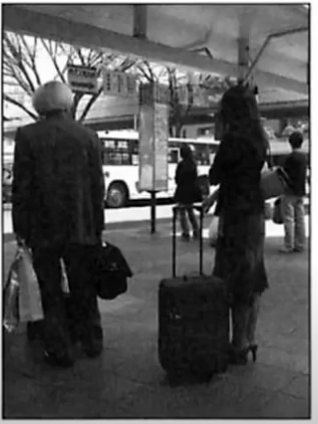
Speak about the image below for 90 seconds. You have 20 seconds to prepare.
Strong answer — score range 130-150
This looks like a bus stop or a coach station, and it has been taken from behind the two people in the foreground. On the left there is an older man in a dark coat and a pale cap, carrying a bag in each hand, and on the right a woman in a patterned coat and heels standing beside a wheeled suitcase. Both of them are facing away from the camera and looking out towards the road, so I would guess they are waiting for something to arrive rather than about to leave. A cream and green bus is parked further along the kerb, and there are a few other passengers standing near it under a metal canopy. The trees behind the bus have no leaves, which makes me think it is winter, and nobody seems to be in a hurry, so the bus is probably not due for a few minutes yet.
Weak answer, and why — score range 60-95
I see two people. They wait for the bus. There is luggage. Behind them is a bus and some trees.
Ninety seconds is a long time. The strong answer fills it by moving outwards: the two figures, then what they are doing, then the background, then an inference about the season and the wait. Stopping after fifteen seconds caps Content no matter how clean the English is.
A written prompt with two or three bullet points, twenty seconds to prepare, then ninety seconds of speech. The prompt stays on screen while you talk, so there is nothing to memorise.
Speak about the topic below for 90 seconds. You have 20 seconds to prepare.
Talk about a gift that you gave to someone close to you.
Model answer — score range 130-150
The gift I want to talk about is a photo album I made for my mother on her sixtieth birthday. I chose it because she is very difficult to buy things for - whenever anyone asks, she says she doesn't need anything - so I decided to give her something that couldn't be bought. Over about two months I collected photographs from my aunts and from old boxes at home, scanned them, and put them in order from her childhood to the present. I wrote a short caption under each one, and on the last page I left space for the years that haven't happened yet. When she opened it at the party she went completely quiet, which is unusual for her, and then she started explaining every photo to my cousins. She kept it on the coffee table for months. That reaction taught me something about presents in general: the ones people remember are the ones that took time rather than money.
The bullet points are not decoration. They are a plan: one bullet, one chunk of the answer. Working through them in order is the cheapest way to score well on discourse coherence.
The task Duolingo added in July 2025, in place of Read Aloud and Listen Then Speak. It is the only adaptive speaking task on the test. Each model answer below is about 35 seconds spoken at a natural pace: a direct answer, a reason, and one concrete detail.
A Duolingo character asks you six to eight questions, one at a time. You have 35 seconds for each answer, and you hear each question only once.
The topic changes partway through — here after question three. Answers get harder or easier depending on how you do, so a set that keeps getting more demanding is a good sign, not a bad one.
Question 1
Let’s talk about where you live. What do you like most about your neighbourhood?
Sample answer — about 35 seconds
The thing I like most is probably how quiet it is at night, which sounds like a small thing but it makes a big difference when you study. It’s about ten minutes from the centre, so I can walk in when I want to, but the street itself has almost no traffic after about nine. There’s also a small park at the end of the road where people take their dogs, and I end up running there most mornings.
Question 2
Is there anything you would change about it?
Sample answer — about 35 seconds
Honestly, the public transport. There’s only one bus route and it stops running quite early in the evening, so if I stay out late I either have to leave before eleven or pay for a taxi. A later service, even just at weekends, would change how I use the whole city.
Question 3
Would you prefer to live in a city or in the countryside in the future?
Sample answer — about 35 seconds
A city, I think, at least for the next few years. Most of the work in my field is in cities, and I like being able to change my mind about an evening at short notice, which you can’t really do in a village. Having said that, I can imagine wanting the opposite later on, when quiet matters more than options.
Question 4
Now let’s change the topic. How do you usually keep in touch with friends who live far away?
Sample answer — about 35 seconds
Mostly voice messages, actually, rather than calls. The time difference with two of my closest friends is about six hours, so arranging a call is more effort than it’s worth, but a voice message gets listened to whenever they wake up. We also have a group chat that is basically just photographs of nothing in particular.
Question 5
Do you think technology has made friendships stronger or weaker?
Sample answer — about 35 seconds
Both, and I think it depends on what the friendship was before. It has definitely made distance survivable — friendships that would have quietly ended twenty years ago now don’t. But it has also made it very easy to feel in touch with someone you haven’t actually spoken to in a year, because you’ve been watching their photos. That feeling is not the same thing as a friendship.
Question 6
Is there a friend you would like to see more often?
Sample answer — about 35 seconds
Yes, a friend from my first year at university who moved abroad for work. We message constantly but we’ve seen each other twice in four years, and both times it took about ten minutes to be exactly as we were. That’s the one I’d fix if I could.
The last task on the test and the longest speaking turn: up to three minutes on one question, recorded as video. Every institution you send results to can watch it.
Record a video response to the prompt below. You have 30 seconds to prepare and up to 3 minutes to speak.
Some people believe that a healthy diet is more important than regular exercise. What do you think?
Model answer — score range 130-150
I would argue that the two are not really in competition, but if I have to choose, I think diet matters more for most people, for a simple reason of scale. It is possible to eat badly enough in ten minutes to cancel out an hour of exercise, and almost nobody has an hour a day to spare. So if someone can only change one thing, changing what they eat gives them the larger return on the smaller amount of effort. There is also an accessibility argument. Exercise requires time, and often money and safe public space, and those are exactly the things that people working long hours or several jobs do not have. Food choices, on the other hand, are made several times a day whatever your circumstances. Having said that, I do not think the evidence supports treating exercise as optional. It does things that diet cannot: it protects bone density, it improves sleep, and the effect on mood is well documented. My own experience points the same way. When I was preparing for exams I ate reasonably well but stopped moving completely, and by the end of the term I was sleeping badly and concentrating worse, even though my diet had not changed. So my position is that diet is the higher-leverage change if you only make one, but that anyone who treats it as a substitute for movement is optimising the wrong thing.
Three minutes is longer than it sounds. The model above takes a position in the first sentence, gives a reason of scale, then a second reason about access, and only then concedes the other side. A structure decided in the thirty seconds of preparation is what stops the answer drying up at ninety seconds.
Written by Kirill O'Nayd
English test expert and educator at TestSucceed, where he builds the Duolingo English Test practice tasks and mock tests and has spent years taking apart how computer-adaptive, AI-graded exams award their points. See all TestSucceed preparation materials.