
Every writing task on the test, with model answers at more than one score band. Reading a strong answer next to a mid-band one on the same prompt shows the four criteria more clearly than any descriptor can.
Sixty seconds, one photograph, three times per test. There is no word minimum any more, which makes it easier to under-write than to over-write. Aim for three or four full sentences that a reader who cannot see the photo could picture.
Write one or more sentences that describe the image. You have 60 seconds.
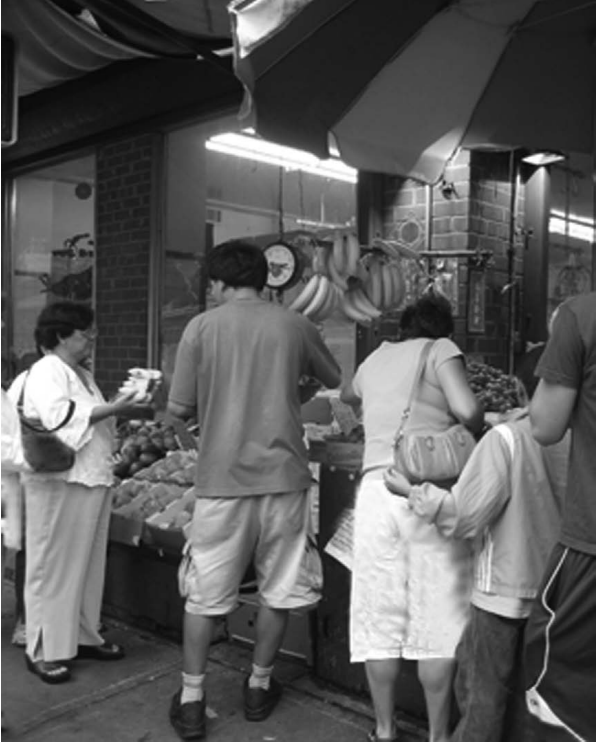
Strong answer — score range 130-150
Shoppers are crowded around a fruit and vegetable stall on a city pavement. A young man in a light T-shirt stands at the counter with his back to the camera, and two women wait beside him, one holding a small carton and one with a handbag over her shoulder. Bunches of bananas hang from a rail above the produce, and boxes of avocados and other fruit are stacked on the front of the stall. A large umbrella and a shop awning keep the sun off the goods, and a child in a tracksuit is half hidden behind the customers on the right.
Weak answer, and why — score range 60-95
This is a picture of a shop. There are many people. They buy some fruits. The weather is good.
The weak answer names things. The strong one puts people in positions, gives them clothes and actions, and reads the scene left to right. That difference is the Content criterion.
Write one or more sentences that describe the image. You have 60 seconds.
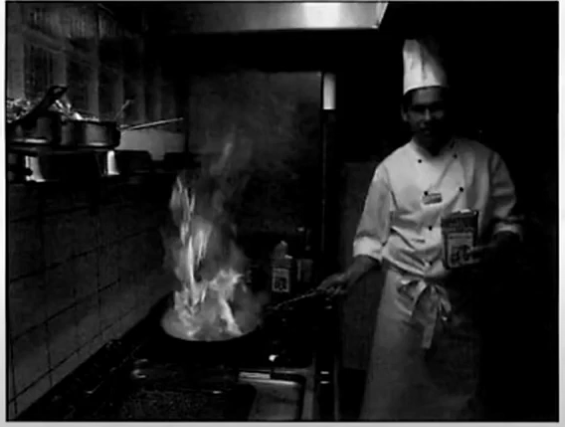
Strong answer — score range 130-150
A chef in a white jacket and a tall hat is working at a gas hob in a narrow restaurant kitchen. He is holding the handle of a wok with his right hand while flames rise out of it, and he is carrying a tin in his left hand. Pans and cooking pots are stacked on a shelf above the hob, and the tiled wall behind him is lined with bottles of oil and sauce. He is looking straight at the camera and seems completely unconcerned by the fire, which suggests this is a normal part of the dish he is cooking.
Weak answer, and why — score range 60-95
A man cooks in the kitchen. There is fire. He wears white clothes and a hat. It is a restaurant.
Notice the last sentence of the strong answer. Saying what the scene suggests, not just what it contains, is what pushes Content from "describes the image" to "fully describes the image".
Two prompts on one topic, five minutes and then three, with thirty seconds to plan before the first. The follow-up question is built from what you wrote, so the task rewards planning two angles instead of one.
Write a response to the prompt, then answer the follow-up question. Both answers are graded together.
Part 1 (5 minutes): Choose one of the following inventions: the car, the telephone, or the microwave. Explain some of the ways it has changed people's lives.
Model answer, part 1 — score range 130-150
Of the three, the telephone changed daily life most, because it was the first invention that let people be in two places at once. Before it, anything urgent moved at the speed of a person carrying it: a doctor was fetched, a message was delivered, a family heard news days after it happened. The telephone collapsed that delay to nothing. It also changed how work was organised. A company no longer had to keep everyone who needed to talk to each other in the same building, which is why offices, and later whole industries, could spread across cities and then across countries. Perhaps the quietest change is social. Relationships that would once have ended when someone moved away could now be kept alive at a distance, and the idea that you should be reachable, which we now take completely for granted, begins here.
Part 2 (3 minutes): Can you give specific examples of ways in which this invention has had a negative impact on people's lives?
Model answer, part 2 — score range 130-150
The same reachability has a cost. Because a call can arrive at any hour, the boundary between work and private life became negotiable, and the modern expectation that an employee answers in the evening starts with the telephone rather than with email. It also made a certain kind of harm much easier: nuisance calls, fraud aimed at older people, and the constant low-level intrusion of sales calls all depend on being able to reach a stranger without their consent. And there is a subtler loss. When talking became cheap, letters became rare, and with them went a habit of careful, considered writing that nothing has really replaced.
Both parts are graded together as one answer. Part 2 asks for an idea you did not already use, so hold something back in part 1 — here the first answer stays positive and the second turns the same three themes (urgency, work, distance) over.
The long writing task at the end of the test. It counts towards your Writing subscore like everything else, and it is also sent, as text, to every institution you share results with.
Write about the topic below. You have 30 seconds to read the prompt and 5 minutes to write. Write at least 100 words.
Some people believe that working in a group produces better results than working alone. Do you agree or disagree? Explain your reasons.
Strong answer — score range 130-150
I agree that groups usually produce better results, but only when the group is built properly, and that condition does more work than the claim itself. A group beats an individual mainly because it fails faster. Four people looking at the same plan will find its weak point in minutes, where one person can carry a flawed idea for weeks without noticing. Different backgrounds also widen the range of solutions considered before anything is committed to, which matters most in the early stages of a piece of work. The exceptions are real, though. Tasks that need sustained concentration, such as writing or detailed analysis, are usually slowed down by a group, and a group with no clear division of responsibility produces less than the same people working alone. My own experience of university projects fits this exactly: the ones that worked had someone deciding who did what, and the ones that did not simply met more often. So the honest answer is that groups are better at deciding and individuals are better at producing, and good work moves between the two.
Mid-band answer, and why — score range 60-95
I think group is better than alone. When we work in group we can share ideas and it is more fun. Also somebody can help you if you don't know something. But sometimes group is difficult because people don't agree and it takes long time. In my opinion group is better because many people have many ideas and one person have only one idea. That is why I agree with this opinion.
Everything here is on topic and mostly accurate, which is why it is not a low score. What holds it down is range: the same two ideas are restated three times, every sentence is simple, and the vocabulary comes straight from the prompt. Content and Lexis both cap out at this level.
Write about the topic below. You have 30 seconds to read the prompt and 5 minutes to write. Write at least 100 words.
Describe your favourite childhood memory and explain why it is still important to you.
Try this one under a real five-minute clock before reading anything else on the page. The Writing Sample is the one piece of your English a human at your target university actually reads.
The fourth writing task hides inside Interactive Listening. It is graded on the same four writing criteria as everything above, in seventy-five seconds.
The full scenario, the conversation it summarises and a model summary are on the DET Listening samples page, because you cannot practise the summary without first having the conversation.
The shape that scores well is three or four sentences: what the situation was, what the main point of the exchange was, and what was agreed at the end. First person or third person both work, and reusing words from the conversation is explicitly allowed.

Written by Kirill O'Nayd
English test expert and educator at TestSucceed, where he builds the Duolingo English Test practice tasks and mock tests and has spent years taking apart how computer-adaptive, AI-graded exams award their points. See all TestSucceed preparation materials.