
CAMBRIDGE · WRITING TASK GUIDE
Picture Story
A2 Key Part 7: three pictures tell a story, and you write it in 35 words or more. The examiner checks that all three pictures are in your story and that it reads as one connected piece.
Where It Appears
| Exam | Paper and part | Questions | Marks | Counts towards |
|---|---|---|---|---|
| A2 Key | Reading and Writing, Part 7 | Q32 | 15 | Writing |
What You See
The three pictures show a simple sequence: something happens, something goes wrong or changes, and it ends. There is no written prompt beyond "Write the story shown in the pictures." It is marked on Content, Organisation and Language, 0-5 each.
Worked Example
A complete picture story task at A2 Key level. Work it with the answers closed, then open the key.
A2 Key — The picnic
Question 32
Question 32
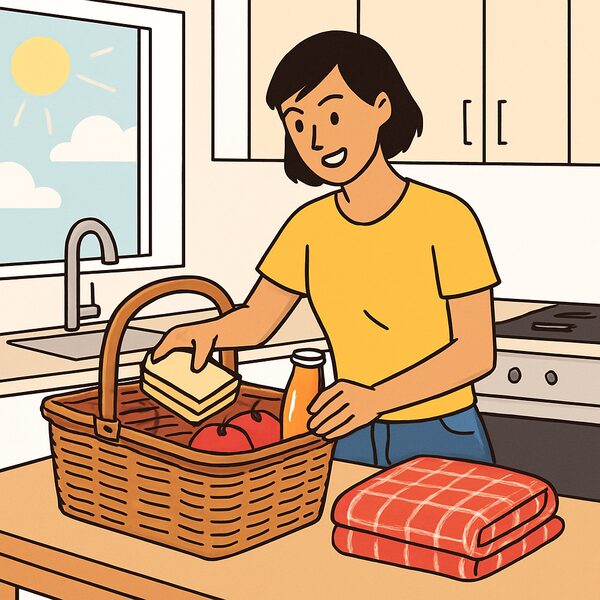
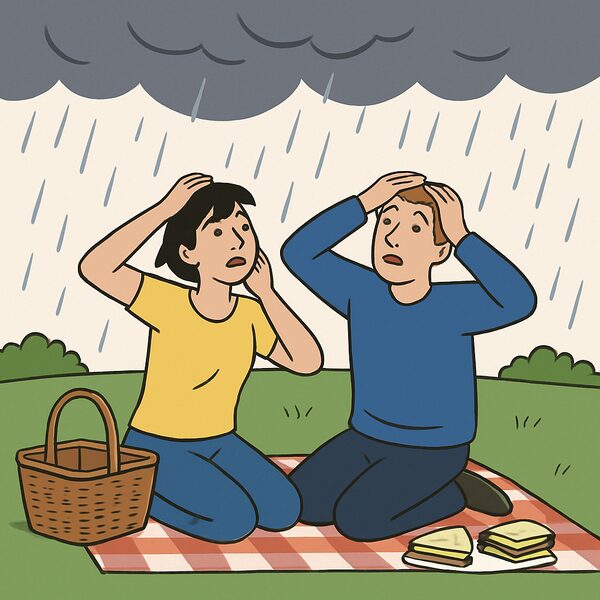
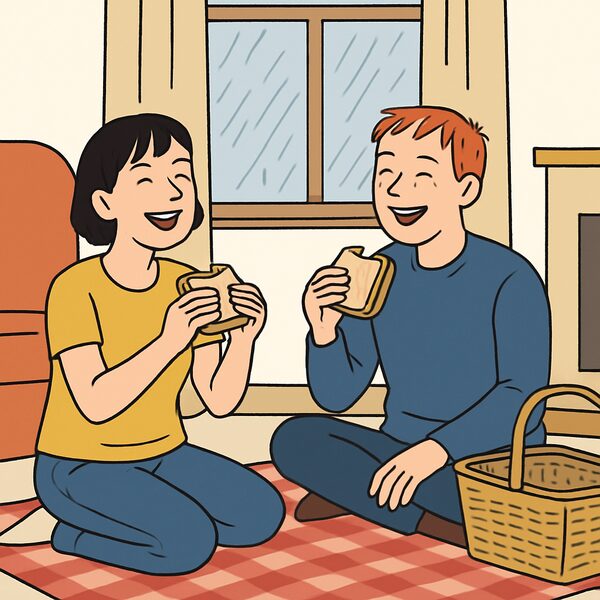
Look at the three pictures. Write the story shown in the pictures.
Write Write 35 words or more..
Show model answers
Model answers
Model answer — Question 32 (story) (57 words, 15/15 marks)
| Subscale | Band |
|---|---|
| Content | 5 / 5 |
| Organisation | 5 / 5 |
| Language | 5 / 5 |
All three pictures are clearly described: the preparation in the kitchen, the rain in the park and the picnic at home, so the reader is fully informed. The story is easy to follow because of basic linking words and time phrases (so, then, but, after ten minutes). Everyday vocabulary (sandwiches, basket, picnic, rain very hard, living room floor) is used correctly, and the past simple is well controlled throughout.
Weaker answer (band 3) — Question 32 (story) (38 words, 9/15 marks)
| Subscale | Band |
|---|---|
| Content | 3 / 5 |
| Organisation | 3 / 5 |
| Language | 3 / 5 |
All three pictures are mentioned, but with little detail: the first is only “make food for picnic”, and the story doesn’t say that they leave the park and go home, so the reader is on the whole informed. The text is connected with basic, high-frequency words (and, after). Basic vocabulary is used reasonably appropriately, but the writer has little control of the past simple (make, go, eat, is), and there are errors with articles, agreement (They was) and spelling (wheather), although the meaning is still mostly clear.
Strategy
- Give the people names and say where they are in the first sentence.
- Write at least one sentence per picture, in the past tense.
- Link the pictures with then, after that, suddenly, finally.
- Add one feeling or reason (because she was hungry). It lifts Language and Content.
Common Mistakes
- Leaving out what happens in one of the pictures.
- Describing each picture separately instead of telling a story.
- Mixing present and past tenses.
- Writing fewer than 35 words.
How to Practise
More practice at every level is on the Cambridge Writing samples page. The whole section in context is on the Cambridge Writing page, and how it is marked is on the scoring page.